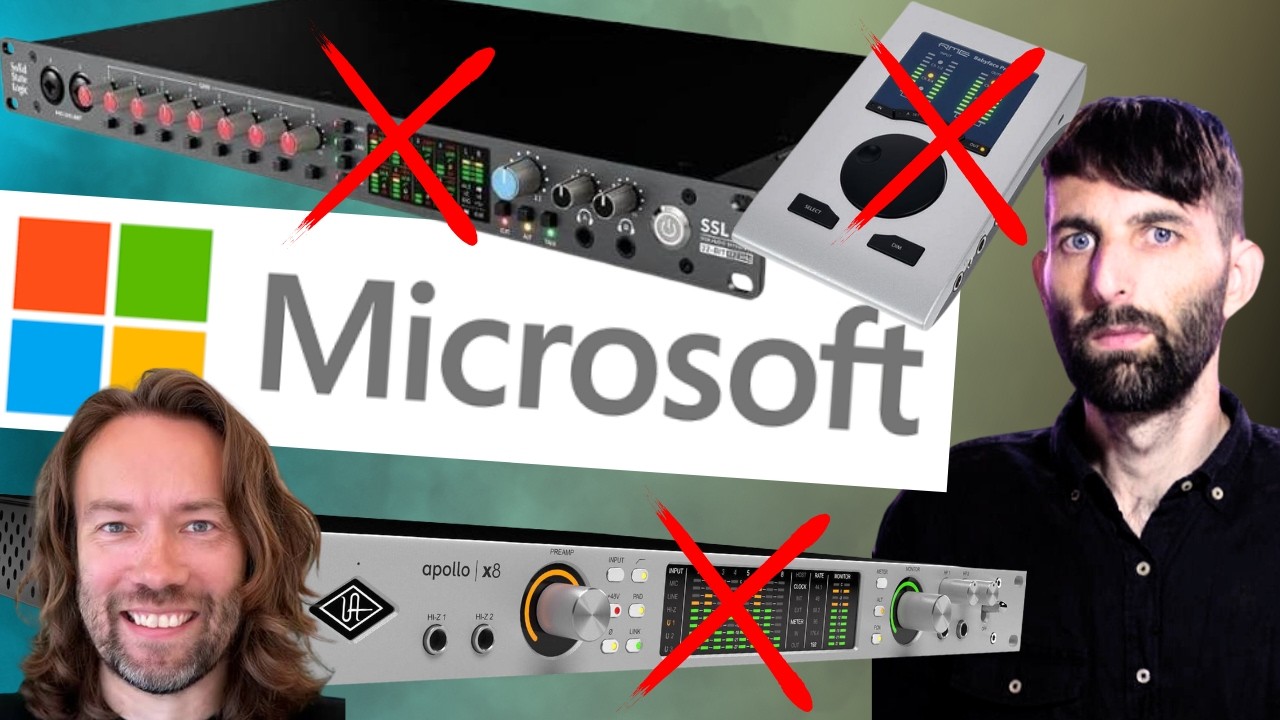
this video was posted on the RME forum, it’s a bit of a rant, but he’s got a point.
This topic doesn’t seem to be about Cubase anymore.
Got to be my top priority, being damned to run MicroSlop Windows. Cubase pro user.
Surely individuals migrating from MS → Linux could result in a fall in support requests, the majority of which must be MS update issues?
Plus the expertise within the Linux user-base and their friendly supportive community spirit may possibly help fix many problems, before contacting the wonderful Steinberg helpdesk.
Contingent on recommending single distro, with beta runs.
Re: Android: there is no way this would make sense, with proliferating of support issues being valid point in this case as streamlining is impossible ..
Agreed, and in that same spirit, the community here is also way more helpful and functions better than the wonderful Steinberg helpdesk. </sarc off>.
Look, if Ubuntu Studio can get 90% of the way with what’s already out there, surely Steinberg could build on that and offer a product on Linux that would at least be competitive with what other vendors have already done?
BTW there is precedent for the idea of offering a feature-restricted version on new technology – when 32-bit-only Cubase 4 was released, there was also an unsupported 64-bit Windows version released for those brave enough to attempt to run it on 64-bit Windows 7.
So let’s hear it for Cubase 16 on Linux!
It’s a wild world out there with new DAWs seemingly springing up every few days. However from experience I very much doubt that LLMs are writing performant low latency audio engines for purely vibe-coders. It’s a different kettle of fish from one-shotting websites or 3D game demos.
Re Steinberg and Linux, if I was in charge I’d want to get Halion on Linux ASAP since there is a pro sampler void to fill and it would have exclusivity in a market with no NI. A chance to take the crown from Kontakt with the next generation.
Getting the entire stable over would be headline grabbing!
Things have changed a lot with ai as a coding tool for translation to different platforms. Seems to me that it is easier and more relevant than ever to get a Linux version. I am fed up with Apple constantly releasing version that causes issues to my soundcards drivers and that the default audio channel is hard locked to channel one and can not be changed in the OS. This is driving me mad so I planning to convert my machine to Linux. I would like to keep using Cubase, but if it is not on Linux I will ditch it and learn something new.
Its incredible that Steinberg is not jumping to make their environment to work on LINUX in 2026.
Steinberg, sincerely, wake up!
Congrats to Steinberg for the Cubase 16 release! It looks very nice, has some features I would definitely enjoy using, and I would upgrade if I hadn’t already happily moved over to Linux.
I still have all my Steinberg licenses in the hope that one day Steinberg will change their minds and start supporting Linux. I have zero plans of ever returning to Windows or macOS, and I’m still doing great on Linux, but I still would love to see Steinberg support Linux one day, and then I’ll be upgrading everything. So I’m still a fan, just no longer using it.
Anyway, wish you all well, just checking in and seeing the nice new features of Cubase and hoping and crossing fingers that Steinberg decided to support Linux, which they obviously did not. I can still hope, right? Steinberg still has a place in my music/post heart and it would be a great day when/if Steinberg decides to support Linux. Cheers! Have a great week!
Yep +1. HALion would be a really good first start, would have an impact and win marketshare.
BTW, just for recent news, Melda announced they are going to explore Linux support, and Melda is owned by Image Line, which makes FL Studio and owns UVI, which makes Falcon. If Melda actually does support Linux, that may trickle back through the Image Line brands, which have many users as you know. I wouldn’t be surprised if more dominoes fall like that. Just a thought to add to the equation. Companies that you might not think, are starting to explore, and many well known devs are already doing it. Acon Digital is now on Linux, and Serum 2, and so forth. Things are changing. I really hope Steinberg gets ahead of this and dedicates some effort to make it happen. Starting with HALion would be a great move.
For sure! That would cause an earthquake IMO.
I’m trying to revive an old laptop with Mint xfce, with this in mind. Various posts on the internet suggest it’s possible to run it under Wine?
That being said, HALion and Analogue Lab can wait. I have a laptop I’m reviving in hopes of simply building a nice little workstation to go with a DGX-670 digital piano. It doesn’t even need to go online once it’s built. Something like qTractor would probably be enough for the task in the short run.
How do you get alsa audio working on linux at all?
I spent a good 12 hours over multiple days with Mint xfce. The consumer apps that I won’t be needing/using will make sound on my laptop and over my DGX piano without issue (Browsers, media players, etc), but nothing else Pipewire/Pulse/alsa works. Tried ditching pipewire and going with pulse. Tried ditching both and going direct to alsa through Reaper, and more.
Even if I remove the DGX-670 from the equation (unplug the USB cable) and mess purely with the built in audio of the laptop, the browsers and media players work, but I can’t get anything else that does audio working.
Best I can get out of it with the digital piano is using XG Works under wine…so MIDI and no Audio (Except when using the media players and browsers that come with the distro). I’d hoped to get some kind of style editor going, but no dice there. Wine chokes on every single one of those I’ve tried (I.E. StyleMagic YA).
Reaper will load up, and kind of play MIDI but it’s all out of time, and it won’t make audio at all for me. I’ve tried every option I can think of to try. Pulse, Pipewire, direct ALSA, jack, and more.
Yep, spent hours on the internet, tried over 2 dozen different ‘this is how’ posts and tips.
I’d like to give some of the linux apps an honest try. Maybe I’ve just grabbed the wrong distro?
Any suggestions? Presently the laptop only has 2gig of RAM (an 8gig kit is on the way), so I’m thinking a lighter desktop option is the way to go. I don’t expect to host a lot of instruments on the setup. Just trying to get the basics well enough to try out some of the leaner linux offerings, with the digital piano making the sounds. Being able to make and play a few stereo audio channels and mix them to the DGX would be nice…
I don’t want to distract from this thread or cause the mods to come down on this thread, just head to a different forum that will cover this issue. Yes, you can get it to work, but depending on how “old” and your RAM limitations, you might need something a little less old. I sent you a private message.
I have NOT been able to get HALion to work with Wine/Yabridge on Linux, and I have tried. Perhaps someone else had more luck. What was kind of cool, though, was that the last time I tried to get any Steinberg app or plugin working, I WAS able to get the authorization working with the Steinberg licensing app. I was pretty surprised by that. So there is perhaps a way forward in that direction if someone wanted to spend more energy on it. Also, maybe Steinberg can consider working on full Wine/Yabridge compatibility as a first step? Who knows.
But in my Wine testing, there were a number of issues. I think one of the Steinberg apps was able to run under Wine (can’t recall which one), but there was something weird with the GUI, etc… So I gave up at that point. I might try again in the future. Wine is constantly under development, and people are constantly coming up with new approaches. So who knows?
BUT now I’ve managed to transition to mostly native, and I don’t use Wine/Yabridge as much as I did at the beginning. In fact I could go 100% native already, but I keep a few special Windows plugins around running on Wine/Yabridge because I like them (not necessarily need them).
My goal is to go 100% native soon, and most of my projects are already 100% native. There are so many great options and alternatives on Linux already, that I don’t “miss” anything from my Windows and macOS days very much any more.
I do miss Cubase and Nuendo, of course, that’s why I touch bases in this forum every once in a while… and Cubase is one of my favorite DAWs of all time, BUT I am very happy with my transition to Linux, and my current toolset of DAWs and plugins is PLENTY for what I need to do. Even post projects now. It’s also inspired me to dive in deeper to the native DAWs I have on Linux and I’ve learned a lot of new workflows and developed some workflows and scripting that are not currently possible in Cubase or Nuendo. So while I miss Cubase and Nuendo, I’ve basically re-tooled around a different set of DAWs and plugins, combined with scripts that are really meeting my creative and production needs, and then some. But still, I would want a native build of Cubase, I’d be thrilled.
Anyway, I would love it if Steinberg released HALion for Linux as the first plugin. HALion is a true powerhouse and I would love to bring it back into my production workflow. To do what HALion alone can do in pure sound design flexibility, I have to use a handful of other native plugins on Linux, which BTW are also very good, but definitely don’t have the same integrated workflow, and libraries, etc. Cheers!
Have you tried this version of WINE that was posted here previously?
I haven’t been able to test it yet, but it claims it can run Steinberg stuff.
No, but I’m keeping my eyes on it to see how it evolves and what the take up is in the Linux pro audio community. Right now it’s limited from what I can see. But it has a number of very interesting tweaks and fixes that are applied on top of typical Wine/Yabridge setups as you know, and it has a lot of potential IMO. I hope it gets a lot of attention, there are good ideas in it.
However, I would not put this into production at this point - in my case - it’s too risky IMO and changing too often, with too many “nonstandard” fixes, AND I don’t need it. Again, that’s just for me, for now, as it is, and for what I need. But it’s evolving and I want to see how the ideas propagate into the main projects that it tweaks, preferably into the main Wine and Yabridge projects at some point.
In my case, I need something that is more stable, tested by more people, has a longer-term track record, etc. And right now that’s still a pinned/frozen Wine Staging 9.21 + yabridge 5.1.1, which has given me the most stable, reliable combo so far.
The 9.21 + 5.1.1 combo is NOT cutting edge, of course, but it works well for what I need, has reliable sources used by a lot of users, easy to get up and running on the distros I use, and doesn’t change every week (or every day!). I do not want experimental or high-churn rate things on my production machines if I can avoid them, and 9.21 + 5.1.1 is the answer for me, for now. This combo will be fine for a few more years easily if I HAVE to run some Windows plugins on Linux.
BUT, Wine has evolved a lot, and now that people are really targeting specific plugin developers for more complex compatibility issues, and are using AI to help (note that even Claude is listed in the vstenv contributor list!), we should see some really good progress solving compatibility problems. I want to see how this evolves and consistent results of more folks using it, and see it stabilize more (look at the vstenv release list, it has updates all the time, that’s way too high of churn to use in production for me).
ALSO, I’m nearly to the point of completely phasing out Wine/Yabridge anyway. I could do it right now actually, since I have native plugins that cover pretty much everything I need right now. The Linux plugin landscape has changed a lot since I migrated to Linux, and it keeps getting better and better. So assuming that trend continues, there’s no point for me to worry about it much now. Once I made the leap to Linux, I began phasing out plugins that needed Wine/Yabridge so I could eventually hit 100% native. I thought that would take years and years. Nope. I’m basically there already. Once I really committed to jump in, it’s not that much more of a leap to go all the way.
But I’m keeping Wine 9.21 + yabridge 5.1.1 around just for the handful of plugins I still really like and want to use. But I technically don’t need it anymore. I was thinking of just going 100% native plugins by the end of the year, but I am a bit lazy to reproduce a few workflows with native plugins… but I might just go for it anyway.
Having said all that, if I could realiably use HALion or other Steinberg apps/plugins under Wine/Yabridge and it was rock solid without using a high-churn “fixer” project on top of Wine, I’d be very open to that.
BUT better than any Wine/Yabridge-type solution is 100% native plugins, right? Hence why I visit here periodically, and write these long posts asking for/talking about Linux support, and hoping that Steinberg is listening. After all, I’m still a Steinberg customer at heart, I still love Steinberg, I still want them in my production workflow, and so forth… but I’m just not upgrading again until Steinberg is on my platform of choice! Cheers!
Always nice to hear from you! I’m glad to hear that fully migrating to Linux works so well for you  Please keep us in the loop.
And of course, fingers crossed that Steinberg is already working on a Linux version!
It seems my previous response to this was flagged as “offensive” so let me try again using slightly more benign language.
I do not wish to give any company carte blanche to my data to profit from, unless they wish to recompense me.
Windows ads are notorious at this point, so not sure why you even ask this?
As I wrote, I do not see any ads on my Windows systems and you did not explain what kind of ads you get. All my systems are Windows 11 Pro and they do not show any kind of ads. So again, try to explain what you see and show some screenshot if you have them.
I have no need to spend hours here because you can disable 98% of telemetry just by switching it off in the settings. A very small amount is always sent, but that is also the case for MacOS and even some Linux distributions do this.
I had two updates in the last five years that I had to remove and I’m currently on the latest 26H2 update.
Instead of just ranting show the evidence.
Thank you @uarte for the updates on how your migration is going, it’s always very informative to read your posts, and you clearly care enough about seeing Steinberg products on Linux that you take the time to come back here every so often.
As always, it is not against any particular OS, so can we please not start the same old “OS wars” again? It would just be nice to have the option to run on Linux too.
No ads on my Win 11 Pro installation.
People seem to confuse some custom installs by computer makers / sellers running a non-Pro OEM version of the OS with ads or whatever showing up with people who buy or build a purpose-built production workstation with a basic install of Win 11 Pro.
No ads on my computer. Ever. At all.
The “Windows ads” complaint is “notorious” because people keep repeating it. That doesn’t mean it’s true.
Thank you! Yes, I’ll continue to drop by from time to time. And yes, fingers crossed that Steinberg is already working on a Linux version!
For me, Steinberg has been kind of my “home base music software developer” on and off for many years… decades actually, back to the Atari ST days. Even when I was mad at Steinberg (or for other reasons) and moved to different sequencers and DAWs from time to time, I would eventually come back to Steinberg.
In other words, Steinberg has held a special spot in my music heart for as long as I have been involved in computer music, with my first MIDI arrangements hooked up to a Yamaha keyboard. Great memories. So I am a long-term customer and have spent a lot of money over the years on Steinberg products, including hardware. I hope one day to continue doing that.
So of course I hope Steinberg gives me another reason to come back, and that will be if they release a Linux native version! At that point, I will, with great fondness and happiness, upgrade… all of the Steinberg apps I have licenses for, which are pretty much all of them.
So I’ll keep checking in. In the meantime, I’m quite happy with Linux choices, and the Linux audio market continues to grow and new great developers jump in all the time. I’m hoping Steinberg does it sooner rather than later. They would have a chance to cause a big shift and build strong roots in that market.