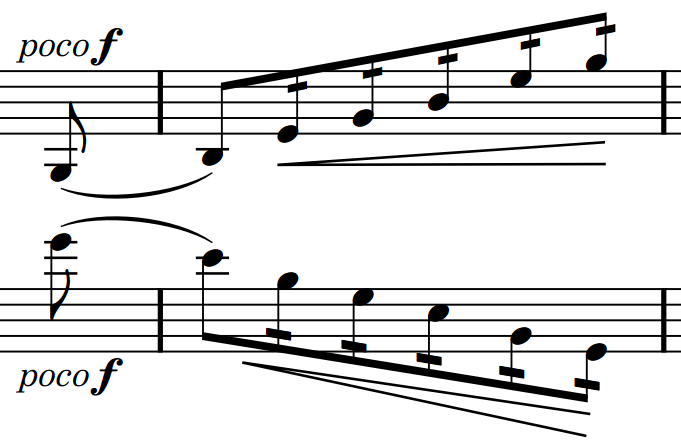
Is there an option to adjust the angle of tremolo signs, so it looks like in the original score?


Well spotted, Juerg.
In Engrave Mode you could drag down the stem of only the high c - until beam and tremolo signs will become parallel 
This under the condition, it is in Violin clef..
ps.: talking about clefs, I just noticed your clever avatar..
Thanks @k_b. It’s a Bass clef (Violoncello). The publisher always wants to stay as close to the original scores as possible. But it’s probably not so important. I thought there might be an option somewhere that I overlooked.
Now let us guess the music.. I don’t recognise that specific bar, but could it be a piano trio in e Minor from the German Romantic period?
You’re pretty close. It’s Novellette op. 59 Nr. 1 in g minor for piano, violin and violoncello (1881) by Theodor Kirchner.
1 Like
Is this what you’re looking for?

Assuming that correct playback isn’t important, I added a buzz roll to each eighth note except the first. Then I used the Edit Music Symbol dialog to change the glyph for Buzz roll to mensuralObliqueDesc2ndBlack (U+E980) and set its Scale to 50.
11 Likes
Yes, @johnkprice, that’s exactly what I wanted. Thanks, I would never have thought of that workaround.


Here we go. A toast to @johnkprice and the Dorico Forum.
8 Likes
To my eye, having these parallel to the beam could confuse them with secondary beams.
Yes, such secondary beaming doesn’t make sense, but if you’re sight-reading, you can’t afford to stop and think.
Having the tremolos at a different angle clearly marks them as a different kind of thing.
It’s a rare score that contains nothing objectionable. If the best you can get is “exactly like the existing version”, then that’s a missed opportunity for improvement! 
There are always cases where I disagree with the editor, but most of the time it comes down to him wanting it the way he wants it. Between you and me, I’m often not happy with Elaine Gould either. You have to make compromises in life. In German, there is a saying: “Wer zahlt, befiehlt.“ In English, this would probably correspond to: “He who pays the piper calls the tune.”
2 Likes