I understand your position, but still the potential Score Editor users are those who are using Dorico, or another notation app, already with some theoretical knowledge.
Most probably the Score Editor won’t be used by the untrained musicians, who are not familiar with any scoring app.
I suppose there will be some people who are going to try Dorico because of the Score Editor in Cubase, but once they find that Score Editor and Dorico Write mode are looking similar, but function differently, they will be disappointed.
The Dorico idioms in Cubase will be welcomed by many of us and will bring more musical meaning to Cubase. Currently it’s way too sound engineering oriented.
Well then your assumption would be quite incorrect.
We address these questions every day. I have been a Cubase user for about 30 years. There are a lot more Cubase users than Dorico users, and this is the Cubase Score Editor, so everything has to make sense in the context of Cubase.
@Thurisaz, this is incredibly rude, inappropriate, and “out of line.” I understand that you would like certain design features, but until you’re hired by Steinberg as head of the Cubase design team, "should" has no business being a part of this conversation.
Are you serious? You’ve used Steinberg products for ten years and still wonder whether the designers think about what they’re doing? It stands to reason — as Daniel stated above — that the visual continuity for Cubase users took priority. Why would you expect a rational product development team to think any other way?
That’s got to be one of the rudest back-handed “compliments” I’ve ever read. I guess the old adage “no good deed ever goes unpunished” holds true….
I always had a soft spot for the old score editor but the new Dorico inspired editor is such an improvement - it looks beautiful as well. Congratulations to the team for bringing this to fruition.
Well, I understand your point and that the things have to make sense in the context of Cubase, no doubt.
Still, I’m sure that if you conduct a survey about those who are using the Score Editor, most of them are educated musicians experienced with Dorico or any other scoring app.
Most of the electronic music and beat makers don’t use it. The previous version of the Score Editor was so outdated, that it was in use just for few people out there.
Still the musical side of Cubase is supposed to have more musical meaning, instead of engineering. As it is in Dorico.
Please, don’t mess the things!
I’m far away from a rude person. Just I’m straightforward.
I’m not aiming to be offensive, just I’m sharing my opinion as it is.
I’m always serious.
I’m a Steinberg user for more than 10 years, actually maybe 14, or 15 years.
For the last 10 years Cubase went far behind it’s main competitors.
Dorico is another story and team behind it. Those guys did a miracle at Steinberg with Dorico.
Cubase 14 brought many important features, most of them had to be there ages ago… Now it can really compete with the others.
I upgraded to Cubase 14 last night because I’ve been working on a new project in Cubase that I will have to bring to Dorico later and so this functionality is super useful for me at this precise moment. Very impressed so far.
I don’t have any precise feature requests like some others have with their laundry lists, because even having this is such a huge and impressive step forward. Instead it is more the impression that I get as a first time user of the Dorico-in-Cubase functionality. Even though I’ve used the Cubase score editor before, the score rendering/display looks a lot like Dorico and I can tell it is Dorico’s output- so much so that my muscle memory kicks in and part of my brain assumes “this is Dorico” and starts hitting Dorico hotkeys and stuff, which obviously don’t work. I think that might be where Thurisaz’s requests are coming from, but I would phrase it differently, in that I have a generalized wish to see the UI experience brought more closely between the two applications in the future where it makes sense to do so. This already happened with the Dorico MIDI editing and play mode - at first they were very dissimilar from Cubase - so much so that switching between the programs and working on MIDI in one vs the other was jarring, but over time, the team made the idioms of working in the Dorico MIDI editor much similar to the Cubase piano roll, so that it became less of an adjustment to switch between them (even though they are still not completely identical). I think making them identical would be too far - it would be weird to suddenly have the exact UI/navigation scheme that is the norm in Dorico imposed on Cubase where it would feel a bit foreign. But maybe there are some ways that the two interfaces could be brought closer to each other in a very general sense, to aid with the users who do work in both. I’m sure this is probably in the works in some ways, so we will see what the future brings there.
I’ve already commented on the expression maps stuff, except that I feel a bit differently from those who just want negative track delay for articulations. I would rather see expression maps built the best/correct way, really well thought out. Solving problems a quick-and-dirty way is exactly what got Finale into such a bad situation with technical debt, and it is much safer and better for the future of Cubase and its users for the team to get expression maps right and do a well thought out redesign, even if it means users have to wait longer for desired features.
One thing I do have a rather strong opinion about - I would very much like to see the MIDI 2.0 Orchestral Articulation Profiles succeed, and do I hope that the Cubase team will put effort into this along with the expression map redesign. Even though it is sort of a chicken-and-egg situation with the inherent risks there from supporting a standard that doesn’t take off, I also think it will likely be an if-you-build-it-they-will-come situation. VSL was quick to adopt “Sound Variations” in Studio One in their player by reprogramming the player to support that, even though only users of one DAW benefited. I feel pretty confident that at least they would be one of the gung-ho early adopters for the Orchestral Articulation Profiles if Cubase/Dorico add support for them, even though it might similarly only benefit one DAW at first.
To be fair, what I said was that it is easier then completely overhauling the entire EM system, which is what they are suggesting is the reason they haven’t done anything yet after years of people complaining about it all over the internet.
Nothing was out of order, I was merely responding to a cute comment with a cute response. Please stop killing the composer fairies.
EVERY time a major software release comes up (say Dorico 6, or Cubase 15…), which developers have worked on for months, discussing the different UI options and functionalities, and solving heaps of problems in the way, and …and …
Then the big day of reveal comes, and then within minutes of download availability a sizeable number of self-professed “power users” know everything better:
“How could you not have thought of this/that/my special wish/… - all the real users know better!!”
Every time.
I can’t imagine a more frustrating recognition… interestingly, other real power users don’t do this (chapeau to @mducharme! )
Ok, [rambling mode off] - but I wanted to voice this …
… let’s keep the forum friendly and cooperative, as @Lillie_Harris says.
Two different workflows. Different priorities in terms of computing resources.
Cubase has a UI concept that has been with it since the 1980s. The tools in the score editor have been where they are a very long time. It makes sense to stick with what Cubase users know, and maintain Cubase/Nuendo uniformity with the rest of the GUI.
I disagree about duplicating the Write mode from Dorico in Cubase/Nuendo. It would be a major step backwards from the existing workflow possibilities in Cubase. Since the 80s we’ve had very robust/tried/true workflows to do step or live input without even touching a mouse or computer keyboard. Cubase composition workflow seeks to make the process a mere ‘extension’ of our ‘musical instrument’ of choice. You play your instruments into the DAW, and the less anyone has to pull out the computer keyboard tray or touch a mouse the better.
Where a Dorico composer might not even have a MIDI controller plugged in most of the time and be more of a mindset to enjoy a busy GUI with all sorts of key combo and pop-up menu options…a Cubase user is typically just the opposite. When I use Cubase I’m on the other side of the room. I need both hands and feet to perform music, and Cubase allows this. Since the 80s I can live or step input a score into Cubase without actually touching my PeeCee. The write mode in Dorico is very powerful in a different way, but it has a long way to go before I can enter a score with it using nothing but MIDI events from my controllers of choice.
It’s also very important that anything running in Cubase/Nuendo be as discrete as possible so it’s extremely lean on CPU cycles and system interrupts. So, I’m glad the dev teams have taken a minimal approach at first with plans to build on it as opposed to just ‘bolting in’ Dorico code with SE level features and seeing how it flies.
For these reasons and more, I’m impressed so far with Cubase 14 on the surface. We’re a step closer to much better collaboration and exchange between the publishing and production worlds.
There are a few frustrating issues, as with every new release. Between ditching the dongle, accounting for no less than three more families of modern CPUs/GPUs, dealing with some major shifts in software dev tools, and implementing newer bleeding edge protocols (MIDI 2.0, MPE, and more), some aspects of life since Cubase 12 and dongle free Dorico 4.x have been a little bumpy…but the road is smoothing out for a much better ‘now and tomorrow’ experience using these tools. Sometimes I just have to roll back to Cubase 11 to make the most of my legacy equipment…but when I want to take an entire project on the road and do EVERYTHING in one little box/laptop/tablet, Steinberg is finally in a position to reclaim ground from competing products (that never supported legacy technologies and never will) and dominate there too.
It’s only the beginning. Tools for live performers to easily manage, display, and ‘interact with’ music in LIVE settings will hopefully be next to benefit from technologies born and developed by the Dorico team…and when this begins to happen there will again be UI and system resource management adjustments. From there, opportunities exist to better integrate Dorico’s underlaying technologies into ePublishing and eLearning environments, and once that takes off there will be doors for AI to access and manipulate musical notation as well.
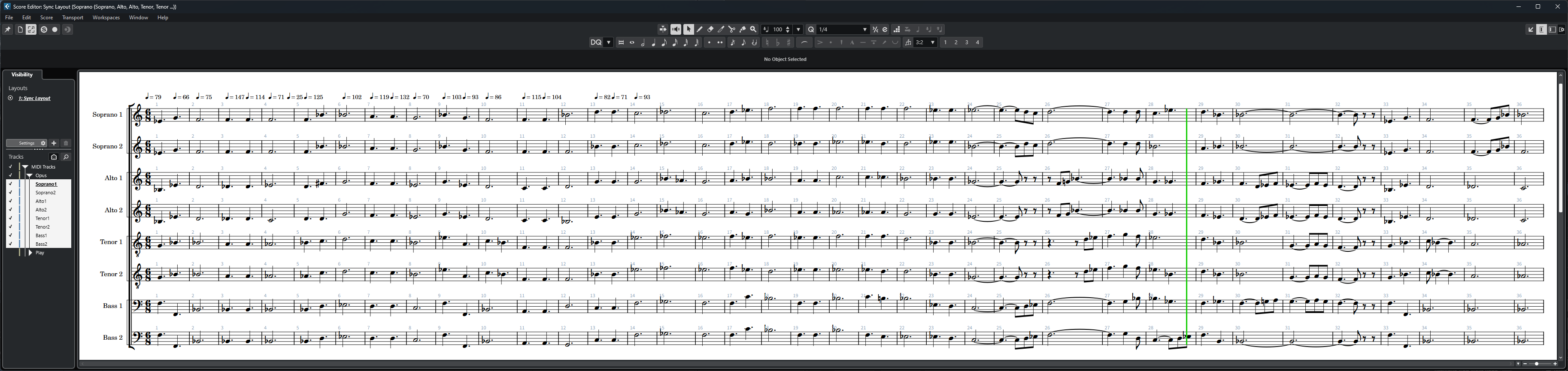
Here is a more simple question about existing score editor in C14; is it possible to configure so that the staff behinds more like gallery view in dorico…in other words…does not wrap down the page, but scrolls endlessly to the right?
Hello @Thurisaz - I can imagine you will still be as creative and resourceful as ever in your music making, with whatever workflow you have been using thus far.
What I mean is, it doesn’t sound like you’ve ever had to turn to the Cubase Score Editor too much (if at all.!) and even though what’s been presented in C14 is something of a disappointment for you, I’m guessing nothing should disrupt achieving satisfactory results moving forward.
Hopefully you’ve found some other (newer) features in C14 too - that make it (have made it) worth upgrading for…
Also lets be clear, there will never be ONE coherent software app that can accommodate all different folks workflows. It will always be the case that we use several different apps for specialist tasks along the pipeline, towards a deliverable…
No doubt that owning both, your idea is the best. Therefore it’s valid for me as well. But as far as I understand the C14 Score Editor has a different target, at least in its initial release state. Actually I have to maintain C13, otherwise all my old scores will be lost. The present state of C14 is for users that are not familiar with the old editor, but want to easily have a look to the score of their music. Nothing to do with a professional notation product, where the final score is the main target. For instance, presently it’s unable to convert correctly a score made with the precedent editor. In other words it’s substantially a MIDI editor more than a notation program. This will change gradually in the future, I’m sure.
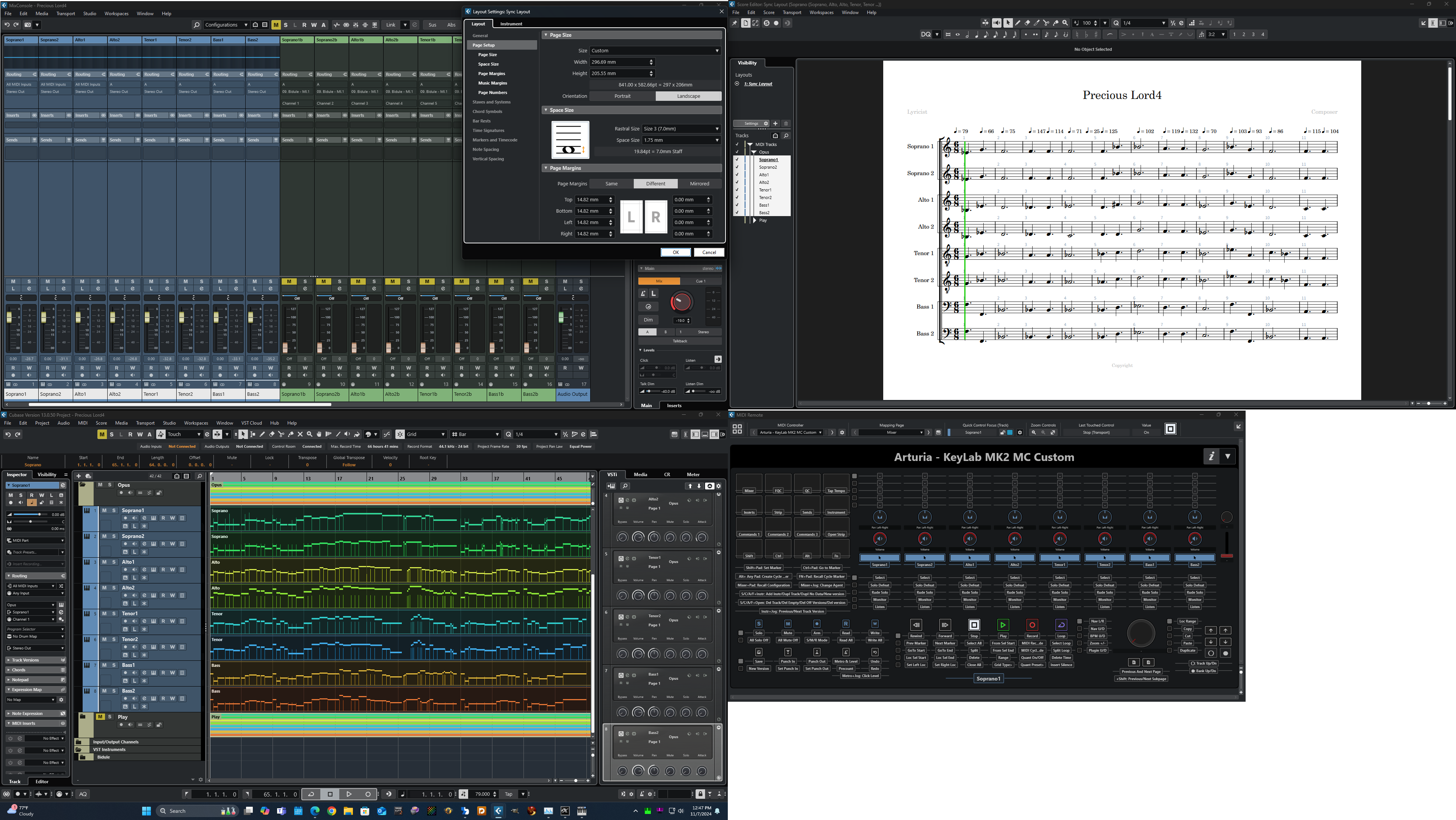
You can get closer to the old ‘scrolling galley mode’ by changing the paper size and orientation (Layout Settings) so it accommodates a single system of staves, then put it in ‘page mode’.
While this won’t ‘scroll by’ like the old score editor did, it does turn the page in real time, and make it possible to make videos of a score playing and such as that.
As a fellow developer, I must notice that the time needed for (proper) development is chronically underestimated nowadays. Or rather ignored. Everyone knows we can’t really ship new and shiny features every year without ignoring old bugs, introducing new bugs which will themselves be ignored and leaving many things half-baked. But we must ship new and shiny cause the show must go on.
I just upgraded to Cubase 14 (from 13), and I am immersing myself into the new wonderful Score Editor: it feels like I am dreaming!: so nicely implemented: the Dorico score look and settings merged with the Cubase style functionalities. Just Wow!!! A truly incredible achievement!! And a Dorico Project export function is there too!
I am so happy about this milestone, like a child at Christmas (and I am very curious and excited to see how this new approach will further develop).
OK, now I have to pinch myself again
A big Thank You to the Dorico and Cubase Teams to have made this a reality!!!