hi everyone,
i’m exporting a project in cubase that was recorded at 24-bit, but i want to export the final file at 16-bit. i m used to this in ableton, there’s a clear option to apply dithering during export, but in cubase, i don’t see that option in the export settings.
so, how do i apply dithering in cubase when exporting to 16-bit a 24-bit project? is there a built-in way to do this during export, or do i need to manually . if so how to do it ?
Thanks
You would need to add a plugin that applies dither on your last bus (or busses) before export. There should be such a plugin bundled with Cubase or you can use a 3rd party one if you so choose.
1 Like
Yes there is Lin One Dither
Just add it in one of the pre-fader insert slots of your Master Bus and choose your settings.
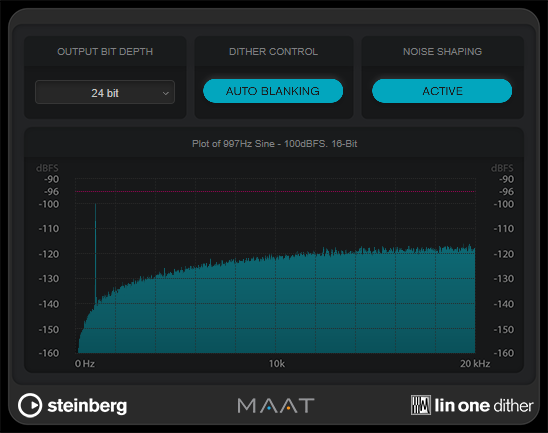
It doesn’t really matter unless you are automating master for a fade out but usual recommendation is to put dither post fader, not pre.
If you export a project from 24 to 16 bit make sure that Noise Shaping is activated, too.
Here’s an excellent tutorial about Dithering by Dan Worrel if you want to understand how dithering works
It does matter if the Master Bus is not at unity.
Not only for an automated fade but also for a fixed-level variation.
The post position is preferred because of the bit change but OP didn’t provide info about his master bus so the pre position will make it a safe choice.
Dither is always better to be last on whatever is going on in terms of levels without altering the dither level itself.
So post fade
So post fade
So post fade
Seems like a contradiction? What info about his master bus would make pre the correct option??
No, you’re making wrong assumptions about my sayings.
It does matter if the Master Bus is not at unity.
Not only for an automated fade but also for a fixed-level variation.
So, my suggestion is to use the pre-fader position if there is an alteration in the master bus volume. Fixed or automated.
The post position is preferred because of the bit change
Yes, post-fader if Master Bus is at unity.
Dither is always better to be last on whatever is going on in terms of levels without altering the dither level itself.
Post-fader if Master Bus at unity, pre-fader if not.
Not really, pre-fader if Master Bus is not at unity.
I guess these are enough to explain my sayings.
There are cases where one would want it pre or post-fader, and plenty of information out there for everyone to use. But each to his own 
Hopefully, OP also had his initial question answered. Cheers
Sorry to be blunt, but this is just wrong. Dithering is the last thing to happen before the signal is transferred into an audio file. Otherwise just don’t do dithering at all.
Yes sure, we are talking about OP’s question of applying dither when exporting a 24bit to 16bit.
Indeed we are. The beauty about dithering is that it is so easy: Always make it the last thing in the signal chain or don’t use it at all. No exemptions.
True but if you have a Master Bus fader at -/+6 and a dither plugin at post position, won’t you have the dither level lowered/raised?
Post fader - it means after the volume change.
What you describe is pre fader behaviour.
1 Like
Oh yes you’re right I was thinking in terms of sends. The point I want to be clear is that the dither itself, as I said earlier, should not be changed in level.
1 Like
So Post Fade…Always. We got there in the end. 
1 Like
Sorry mate, you’re right.