I want to compile some ideas of what SpectraLayers could implement as future features.
In the last couple of years a lot of AI stuff was added, which is nice, but it’s often based on free open-source solutions, so you don’t necessarily need SpectraLayers in the first place.
On the other hand, there is a lot of potential in the spectral editing part, which I think is way underutilized, especially for sound design.
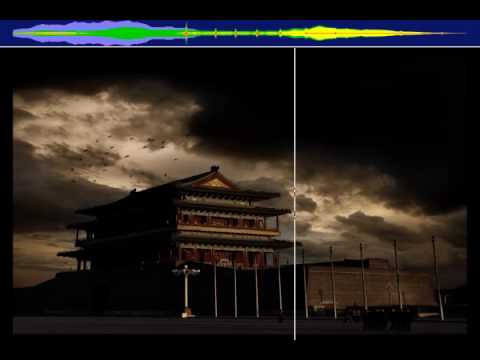
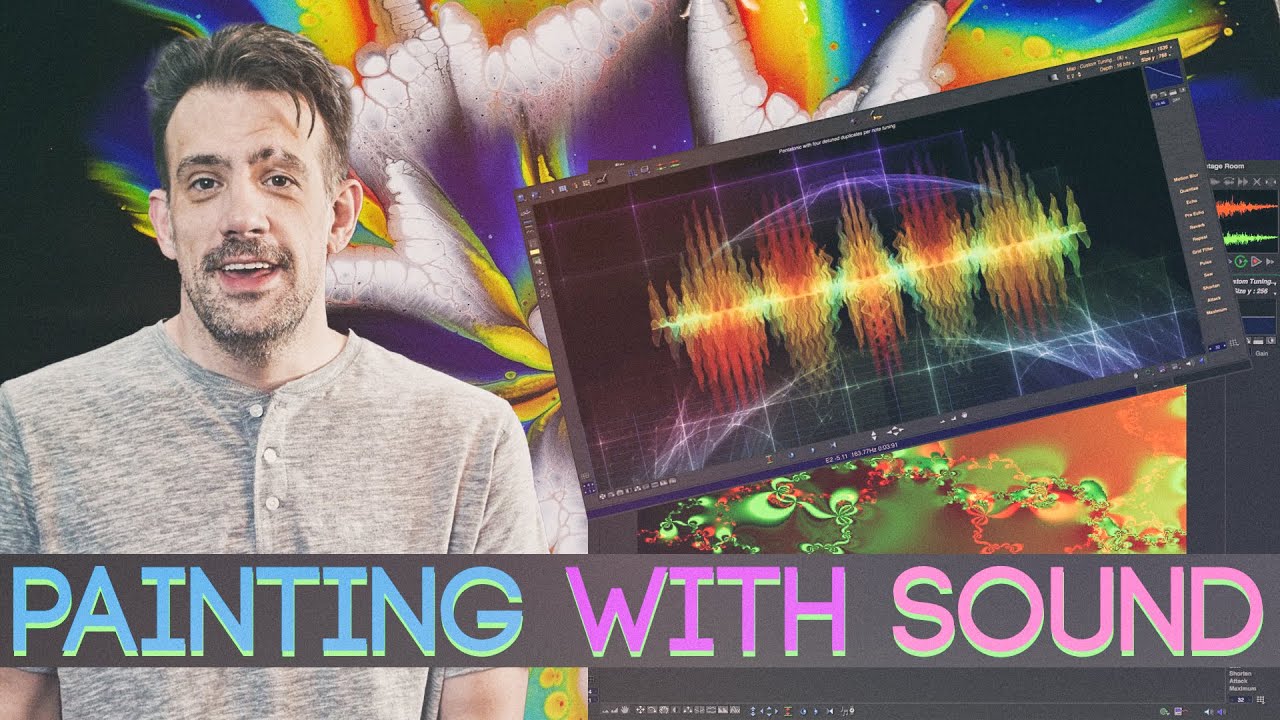
Photosounder is excellent for this (although the user interface somewhat buggy for me), as it allows to import and export spectral image as normal image files. These images can then be edited in any image editing application which results in all sorts of unusual sounds.
The reimported images can later also be “performed” in real time by manually moving the playback cursor and recording the output.
It would be really great if SpectraLayers could offer something similar and could also add various image filters, so you don’t need to do the round-trip editing with external applications.
Unfortunately, Photosounder is a one-man project, so it’s development speed is glacial.
Another program that enables creative work with spectral images is U&I Software Metasynth. I’ve never used it, as it’s only available for Mac. Compared to Photosounder it integrates DAW-like features, which lets the user build song structures out of synthesized images.
Spectralayers is a gem on a stockpile of gold, but I don’t believe the main developer nor Steinberg realize this nor the potential it has.
I agree, an official image format for audio should of been standardized years ago. Also a consideration of combining both stereo files to mono (just like in photosounder) is noteworthy.
I think the uncompressed TIFF file format export in Photosounder is a good solution because supports extremely large resolutions and is already supported by many image editing applications.
For example, the hearable frequency range for humans goes up to around 20 kHz. Technically, you would need 20.000 pixels in height to resynthesize full audio details.
Of course, the standard values in Photosounder are much lower. But editing a low resolution image and reimporting it into Photosounder will result in sounds that miss a lot of their original details and therefore sound very organ-like.
And the width of the image depends on how many samples you want in a second. Photosounder has 100 samples per second as its standard value (but the sample resolution can be changed). This results in 100 pixels per second of audio. But you might lose some attack with that value and need a higher one, for example 500.
This results in a 20.000 x 500 pixel image file for one second of audio. For 32 bits per pixel, that’s about 40 MB each second in mono. This usually preserves a lot of details, but Photosounder might get instable. Therefore this is only recommended for short sounds, maybe 10 seconds long.
I’ve noticed and observed that one thing companies don’t do anymore is acquire other companies to make their own products better. For example, the Fisker Ocean is actually a good vehicle, it’s just that the guy(Henriq Fisker) who manufactured and produces those vehicles became so greedy that something as simple as paying software developers a fair decent salary became trivial. Henriq Fisker mindset(when he was producing the Fisker Ocean) was “let me pay these software engineers whose making the software for my vehicle the bare minimum and expect these same software developers(who I treat like sh*t) to go above and beyond for me”. So what ended up happening is that the software engineers did just that, all they did was the bare minimum and then something as trivial as an “OTA update” caused the company to go bankrupt. If I were someone like “Elon Musk” I would have immediately seen the value in Fisker Ocean the moment it was in the early stages of filing for bankruptcy and would have jumped on the opportunity to acquire “Fisker Ocean” because it’s a great vehicle.
I bring all of that up to make the point that both Metasynth and Photosounder are great tools, but both of them could be acquired and implemented into Spectralayers to make Spectralayers significantly better, however it seems like companies these days has lost that vision. A lot of people don’t know this but that is what the main developer of FL Studio did, he had set out to do a additive synthesizer and had someone else build the foundation of it(Morphine) and then perfected the designed with his own synth(Harmor). If I were the main developer of Spectralayers, I would submit a business proposal to Steinberg to heavily invest into acquiring other companies such as Photosounder and demonstrate the value there, so you can make Spectralayers better.
I think this is very bad idea. I would be very upset if Steinberg would do this.
I don’t think these guys have any patents that might prevent SpectraLayers from introducing a similar feature.
Creating sounds from images basically works by filtering pink noise. Each line of the image represents a certain frequency range and each pixel represents the amount of how much this pink noise frequency range is mixed into the whole audio signal.
I don’t think that Steinberg needs to buy and end other products for this. Especially since U&I Software makes a couple other very unique softwares like Artmatic. It’s the same with developer of Photosounder. He made other interesting spectral plugins.
What you’re saying defeats the point snd purpose of your own post.
You just need to prove that your idea was the original idea before a judge. Patent and copyrights and trademarks is there as a systematic design to ensure checks-and-balances. What you create belongs to you (no matter what) and nobody has any right to be INSPIRED to steal nor exploit from you (regardless of if you apply for a trademark or a copyright and a patent). Of course if you don’t have a trademark/patent/copyright it’s going to be a lot easier to lose a case but its not the one-all-be-all solution.
It’s much more than that
Yeah but the developer of Photosounder hasn’t really done anything with it.
Worst case scenario is, that Steinberg absorbs the company and then it goes nowhere.
The same happened with the Wolfgang Palm plugins which were acquired by Plugin Alliance and BrainWorx and then they simply vanished, never to be seen again.
Photosounder gets at least updates and bugfixed somewhat regularly for a one-man-project.
This is not how patents work, especially not software patents.
Generally, there shouldn’t be any problem. This stuff is around for decades. Metasynth’s first version came out over 25 years ago.
I am sorry, but that is just an absolute niche use case. How many people really do wish to create audio from images?
I’d rather prefer Robin to concentrate on productivity improvements for a broad user base - batch processing for example could need a lot of improvements for what it can do. Currently it is rather useless for me as everything it should do, it doesn’t. So I have to do repetitive work still manually, although it could be automated if the batch processor would be more powerful and flexible.
For complex batch processing I use Sound Forge, because it can be scripted to do basically anything. Such a flexibility would be awesome for SpectraLayers.
If that was true Spectralayers would be stable & would not rely on multiple third party unmixing models. This aspect of the program is a fail and he has been unable to fix it properly.
Yup, it is limited in a way and very interesting in other ways.
The user selects an image and pastes it into the required spectrum area. Select an area, freely designated in time and frequency and paste the image with more or less intensity.
The possibilities are tremendous and many of the options that other image-to-audio converters provide while converting can be applied after the conversion in Wavelab.
For me the most interesting part of the “Image-to-Audio” conversion in Wavelab is the possibility to freely select the spectral area of insertion in an existing audio file.
That being said, what i meant, above all, with my post was that Steinberg “owns” the technique and the know-how to implement it.
I guess they don’t want to.
As they don’t want to implement proper metering in Spectralayers despite the incredibly complete metering options in WL.
Maybe they don’t talk to each other.
It’s as if this was a display of Multiple Personality Disorder.
FWIW.