If I need to insert notes and rests in a passage, I select Insert. I can select a note value, play a key and everything after that gets moved over by that value. If I then press the space bar, which is what I use to enter rests in the first place, the caret simply moves to the next note. Why can’t I press space to insert a rest by that same value? As it is, to insert rests I have to click on the rest symbol, move the mouse to the score and click where I want the rest, move back to the palette and deselect the rest, play the next note, and then repeat the whole procedure for the next rest. I must be missing something…
You’re right, but it seems to work if you type a note name, like F, when the rest icon is selected.
1 Like
Yes, Claude has got it; if you’re in rest mode, any note name (A-G) will insert a rest of the actively selected duration. Rest mode can be toggled on and off by pressing the comma (“,”) key.
Thank you, but good heavens, how is one to guess that? It’s hardly intuitive and I couldn’t find it in the documentation anywhere. Believe me, I looked, also here on the forum.
2 Likes
it doesn’t always work. i have a two measures both marked 4/4 with a missing 8th note in each case. placing the cursor in those measures and trying to add an eighth note to round out the measure doesn’t work. instead of placing a rest, the cursor simply moves to the next measure. as an example, see measure 67 of the attached screen shot. trying to add an eighth note to this measure using the described method does not work.
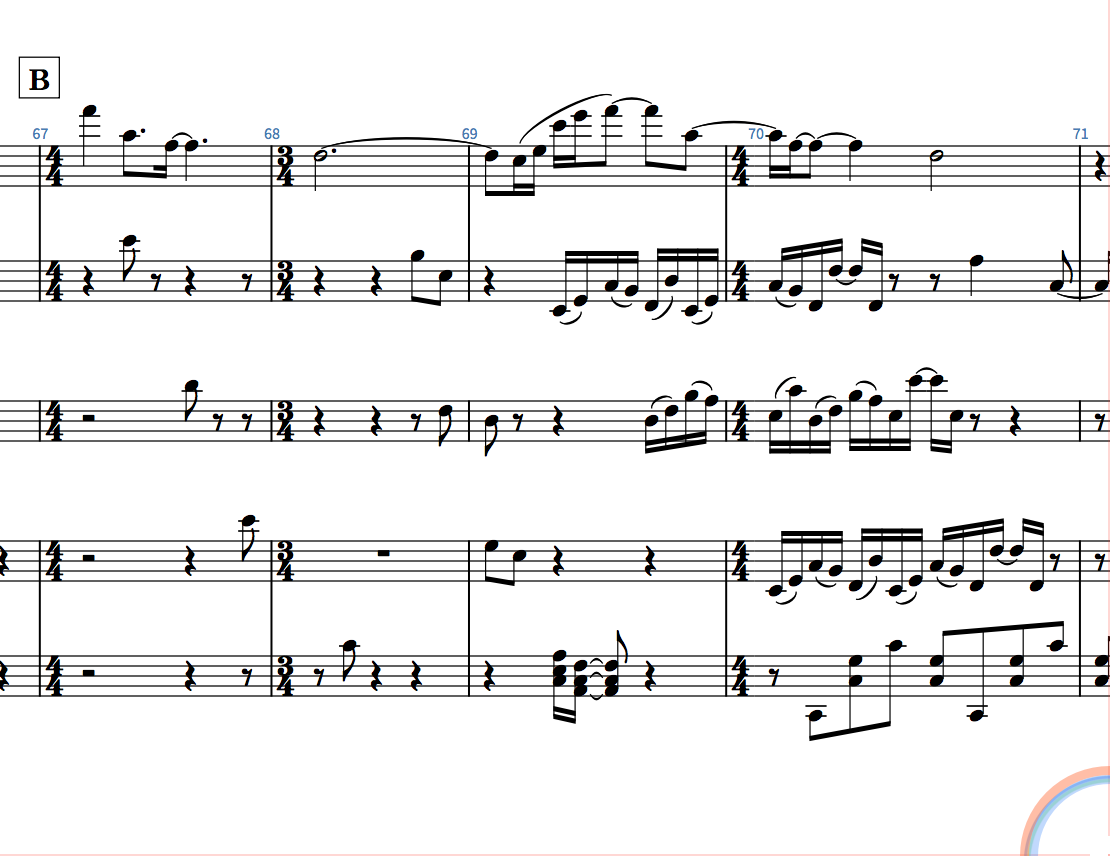
To me, this is not a solution. At least part of his point (and I agree) is that having to move the right hand from the number pad (or the left hand off the MIDI keyboard) is disruptive to smooth note entry, especially in Insert Mode where it trips me up most often. Far more intuitive and smooth would be that pressing a duration when no MIDI key is pressed just means insert a rest of that duration.
Keep in mind that in most cases, you don’t need to actually insert rests in Dorico – you just need to advance the caret (with the space bar or arrow keys) to the next position where you want notes, and Dorico will provide the rests for you.
You can also assign your own shortcut keys for things like rest mode, if you want.
1 Like
If you use duration before pitch, that is nonsensical. All you could do would be to enter rests!
(I don’t understand your reference to Insert Mode)
“If you use duration before pitch, that is nonsensical. All you could do would be to enter rests!”
I cannot speak about duration before pitch because I have not found an adequate brain donor or neurosurgeon. I always use pitch before duration and this feature I am suggesting could come into play only when that is how note entry is being done.
If you hold down a MIDI key and press a duration you get that pitch for that duration. I suggest that, when you do NOT hold down a MIDI key and press a duration you get a rest of that duration. It is completely intuitive: one hand does durations (doesn’t matter if it is a note or a rest), the other hand either sends a pitch (for a note) or sends no pitch (for a rest).
“(I don’t understand your reference to Insert Mode)”
It is most problematic for me when Insert is on, because the notes entered are inserted cleanly and push the existing notes ahead of them, but when you want to insert a rest the cursor no longer pushes the notes, it just goes on top of existing notes. Switching in and out of Rest mode with the comma key is slow.
Yes, I fully understand that. However, when trying to insert notes and rests cursor keys just move the input caret over existing notes instead of pushing them along. In insert mode I would like the duration key to insert a rest and move the following notes along just as inserting a note does.
Isn’t that something SHIFT + B plus a rhythmic value can do already?
I’m agree with your assessment about entering rests. With Finale I could keep my hand on the number pad to determine durations while I kept my other hand on a midi keyboard to determine notes. I didn’t have to look up to find the comma button in order to enter rests.
A similar issue occurs when entering ties. With Finale my hand could stay over the number pad and simply push the “=” key to get a tie. Now I’m having to look up and reach over to find the “t” key. It’s very disruptive and time consuming.
I’m still new to Dorico and learning. Are there faster ways to enter rests and ties without having to look up and reach over for ties, rests and dots?
Also: The period button “.” on my number pad doesn’t activate the dotted rhythm mode. I’m having to reach over to the period button to the left of the number pad. Another disruption.
In general, you never need to enter rests in Dorico like you did in Finale. If you’re using numpad input just arrow the caret over to the next note location with your thumb and input it, and Dorico will automatically fill in the rests. Dorico is by default set up for use without a numpad, but one great feature of Dorico is that you can program your keycommands to be whatever you want. I use numpad / for ties and obviously numpad period for a dot.
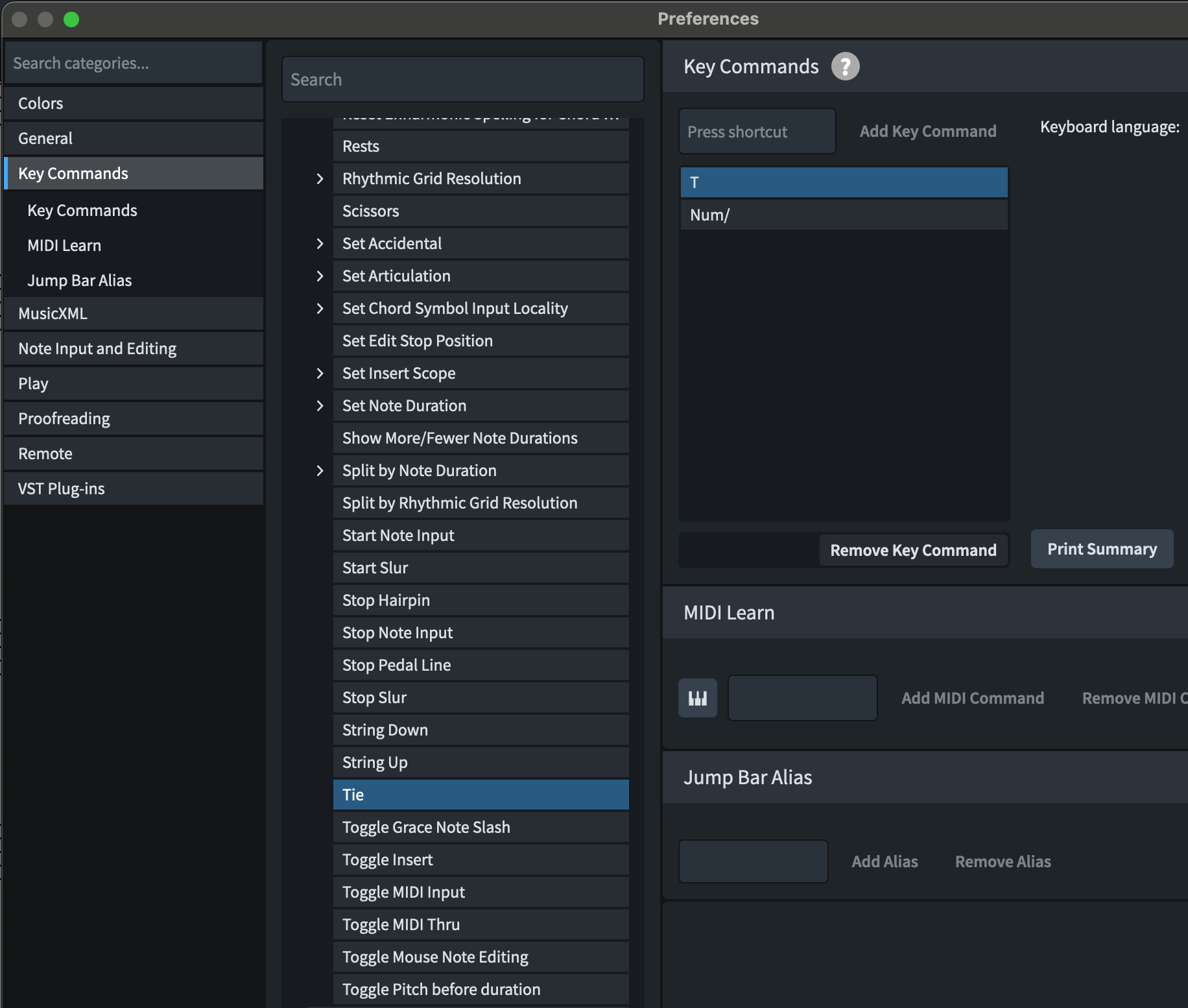
Feel free to use Preferences / Keycommands to program numpad shortcuts to speed up your workflow. Welcome to the forum! There are a lot of us ex-Finale users around here.
2 Likes
…or use the spacebar. The arrow will advance the caret by the rhythmic grid duration, while the spacebar will advance the caret by the currently selected input duration.
Personally, I find the spacebar more like “entering” rests – pick a duration, press space – but a lot of this depends on workflow choices (e.g., pitch before/after duration, MIDI vs computer keyboard for pitches).
Spacebar just means I have to move my hand off the numpad, or take my other hand off my MIDI keyboard, while my thumb is already resting on the right arrow when I use the numpad. I seem to recall @benwiggy uses that spacebar method, but reprogrammed it to be numpad 0, but maybe I’m thinking of someone else. (I’m personally almost always using pitch first MIDI input.)
It’s my one concession to Finale’s old ways. (Well, that and Command L for Lyric Window…)
3 Likes
I never (very, very rarely) use the comma to enter rests. It is much quicker to advance the caret.
To facilitate this it is useful to set shortcuts for changing the rhythmic grid that mimic the keys that set durations. (Personally I use eg. ctrl-6 to set the grid to crotchets etc.)
It is simpler (and quicker) to enter the whole duration of the tied notes as a single note
A double tap on a note duration should activate a dotted note.
Right – like I said, this depends on workflow choices. I use duration before pitch, and I use the computer keyboard to enter notes; I have the keys Z-M mapped to the pitches C-B and use the numpad for duration, so it’s perfectly natural for my left thumb to hit the spacebar instead of a finger selecting a pitch.
1 Like
Wow… thank you, Dorico community for your help! With your suggestions, I’ve looked up and learned how to set up key commands, and it’s made all the difference. I’m now able to keep my hand over the number pad without looking up to add dots and ties, and I’m working much faster.
3 Likes
Can I beg Dorico, in pitch before duration to allow us to add rests with the number keyboard (yes, just like in Finale). I keep hearing that there is no need for this, but (for those of us who are used to speedy entry), this is SPEEDY! Using the arrow keys or spacebar to advance the caret means moving the hand off the number keys and this is objectively slower as it takes your eyes off the sheet music you are entering. If I have to go into ‘rest mode’ then it’s another toggle. Honestly, guys - this would be such a handy feature to have. I can assure you, I have really tried to learn Dorico ‘afresh’ and not just recreate Finale. My conclusion is that the Finale speedy entry is the quickest way … I just entered some music and I estimate it took my 20% longer without being able to enter the exact duration of rests I wanted with a single keystroke.
If you feel the same way, please chip in and someone might listen.