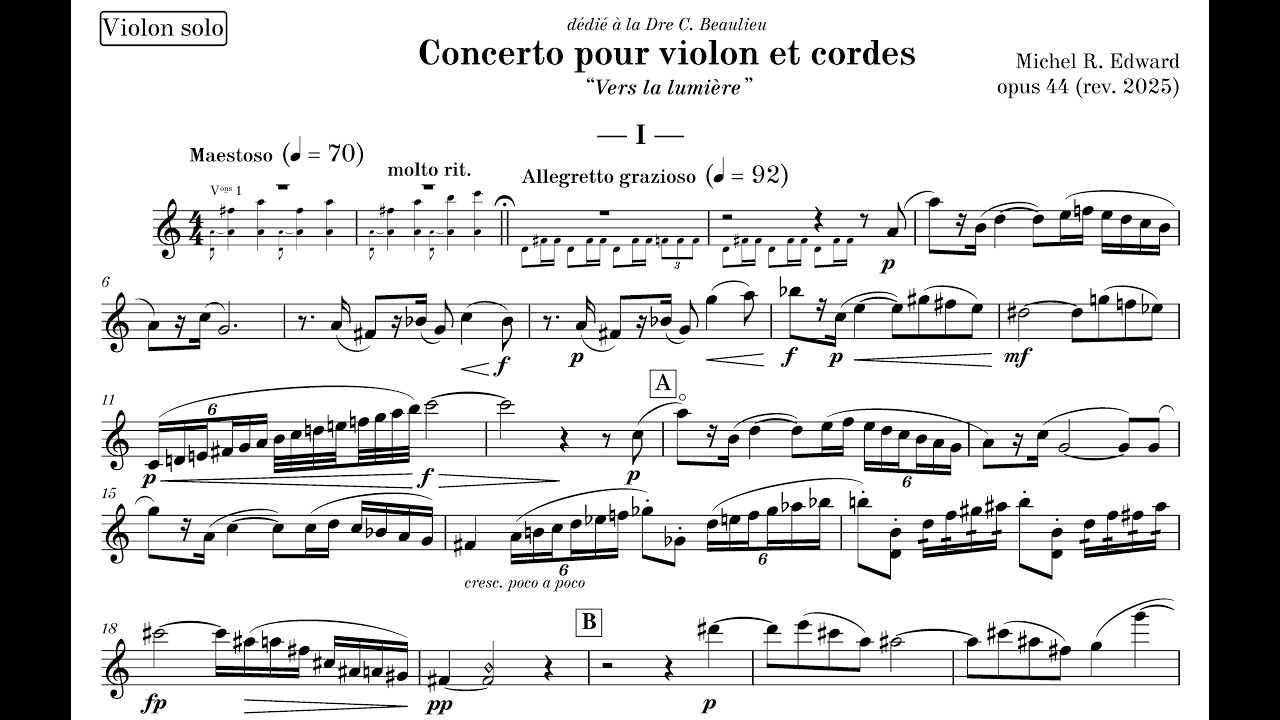
Here is the last movement of my concerto for violin and strings. The instruments are all from Noteperformer.
What I find interesting is how much more at ease I was while writing this.
The first two movements of this concerto were actually the very first test piece I entered into Dorico 3 after abandoning Finale.
A few things here that I enjoyed doing, or that became more comfortable for me:
1 - open time signatures
2 - hiding time signatures and tuplets
3 - different forms of tremolo
4 - coming back and adding beats into measures, lengthening them, sometimes shortening them, basically, modifying the time signatures of many measures.
5 - being able to create composite time signatures with dashed barlines showing the inner sub-division
6 - obviously preparing the parts, with cues and some elements showing or changed in the score differently than in the parts
7 - beaming across barlines (more tedious to do in Finale, far easier in Dorico.) While my music may be in a more direct idiom, not having as complex requirements for this cross barline beaming, it’s obviously quite possible to do where more complicated results are needed.
So overall I’ve been extremely happy with Dorico (now on version 6) doing what I needed, and my speed is at least equal to that I had with Finale, if not faster (not really needing to worry about layout for parts, automatically created and requiring minimal correction has been a god-send.)
So without further ado, the finale of my violin concerto, with a score video (PDF file exported from Dorico, then Adobe to create image files from each page of that PDF, and dragging and dropping into a project in Shotcut the audio and video aspects.)
There are probably a few spots where the layout isn’t ideal, but that’s because I did a quick and dirty version of the score in landscape mode without spending too much time adjusting numbers of bars on a page etc…
my problem is rather the opposite. I’m not in general a fan of violin concertos – at any rate the romantic warhorses – but I found this in many ways fascinating with a particularly moving central section. The problem is the sterile NotePerfomer rendering as I see it – would love to hear this with a decent sample library (or of course live). Having said that, the soloist is not as bad as the accompaniment, otherwise I doubt I’d have managed to get through it which would have been a pity!
I’m happy with the sound.
I can’t afford expensive VSTs, nor can I afford to spend the required time to learn how to use a DAW.
So for me, this is the best I can afford, both financially and time-wise.
Having heard two movements of the concerto live, I’m actually quite satisfied with the sound.
And I’m impressed with what Dorico and NotePerformer were able to achieve. Could the violin soloist sound better? Obviously, but like I said: time and money.
you don’t need to learn how to use a DAW – you can get much better results from within Dorico itself. But if have no time or money, you’re happy with the results and the people you actually want to listen to your music are also then that’s obviously fine – or if it’s just a score-reading exercise.
But NotePerformer was never designed on its own (without the now sadly discontinued NPPE extension) to be more than a proofing tool in preparation for a live performance. You have to decide what your target audience expect.
Seconding dko22 here - if you can download NotePerformer 4.5 and get ahold of a library when it’s on sale (I’m using BBC Symphony Orchestra Core), it sounds great. And in the long run, I’m guessing that something like the very impressive Cantai, but for orchestra instruments, will become available.
NotePerfomer NPPE has worked wonders with the BBC SO – that seems to be the almost universal opinion. I’ve never been able to get the same results with the orchestra natively which is presumably what @Michel_Edward has tried (not the case with the Spitfire Symphony Orchestra where I’m happy with my own maps). Still, it does of course depend on the sort of music – the BBCSO and Spitfire orchestras in general are best for warmly romantic music which is not necessarily what is being written here. And the native NP woodwind and brass are more or less acceptable – the strings are the weakest link which of course is unfortunately what is exclusively being used here.
But, as I’ve said before, I’m only expressing my own taste and the finer qualities of the music still more or less shine through.
I DO use NotePerformer’s NPPE for playback of BBCSO.
I still get uneven dynamics, non-legato notes under slurs, etc..
Yes, the string sounds themselves are superior to the synth sounds from NotePerformer, but the NP sounds actually play in a more accurate manner, respecting articulations and dynamics, which the NPPE version of BBCSO does not.
Anyway all to say that I’m perfectly satisfied with using the sounds from NP for my simulations. The point is to get an idea of the music, not to make a recording that replaces the live performance.
I have BBCSO Core, but my processor and 32g of RAM isn’t robust enough to use it by itself (except with 3 or 4 voices)-even with John’s template. So, I use my Spitfire Libraries (Core & SSO 2024) with NP 5.0 and its playback engines. Otherwise, those libraries aren’t really very useable for me. With it, I can do full orchestrations. Spitfire expressly gave their OK to use their libraries with NP5.0 during the ‘kerfuffle.’ I have NP 4.5 as well, and can use more instruments with it, but it still can overtax my system sometimes in larger works.
how on earth do you manage to use the SSO under NP5.0 with 32Gb RAM? I ruled out even trying to create the Preload with my mere 64Gb. Partly I guess that was because of my generally negative experience (despite the odd thing I liked) with the results of the BBCSO and Cinematic Studio. Like most people who find the main point of NotePerfomer to be the playback engines, I reverted to 4.5. For the SSO, I use my own maps having tried 4.5 in trial mode (obviously I can’t buy the plug-in any more) but finding on this occasion, the NPPE was overall less compelling.
yes, but for larger orchestral works, the chance of getting a performance which reaches, far less surpasses the level of a reasonably competent mock-up is pretty slim for most of us. The few in a lucky position to be able to get performances by professional symphony orchestras have no need of anything more than NotePerformer. For the rest, the mock-up is the finished product – until better libraries come along of course…
I AM speaking only for myself. If others want to go the extra mile and make recordings with more expensive sample libraries, then they are free to do so. I’ve heard some really beautiful ones. I just have no interest in doing so. It’s not for me.
I can do full orchestrations with SSO 2024 in NP5.0. The nice thing about NP5.0 is that, as I understand it, is it eliminates some of the layers of sampled data (a potential downside, I know) in the preloading process which keeps the sampled sound elements but greatly reduces the memory load required to use them. Without NP5.0, I’d have to pay a lot of money I don’t have to buy a new, high-end machine to use my libraries. Even NP4.5 with my libraries limits me to smaller works due to my memory- though it sounds nice. With the BBC SO template (no NP), I’m lucky if I can get a quartet/quintet to play without hiccups.
yes, that is indeed the key, I think. It would take probably near enough a day to render the SSO but once it’s done, the system requirements are indeed reduced. At the expense of a fair amount of the sampled data, unfortunately which I couldn’t live with after trying the two libraries I had licensed plug-ins for. But some have been more positive and i myself found some things to like. If the development had continued, it could potentially have been a very useful alternative to the v4.5 plug-ins. But we all know it wasn’t to be, despite at least two of the main vendors (VSL and Spitfire) having no objections.
Indeed. For purposes of arranging/composing in Dorico and being able to produce good-quality audio demos of my work, NP 5.0 works very well with all my libraries, even in full orchestral works. Were I a DAW composer for film, games or TV, that loss of depth in the samples would be a problem.