I’m new to Dorico and curious if most of you are doing your music composition in a DAW - then importing to Dorico - or starting and finishing in Dorico.
I don’t mean to be as ‘smart-aleck’ as this is probably going to sound, but: I start inside my head, and then use Dorico second.
I’ve never touched a DAW and wouldn’t know the first thing about how to use one.
I usually start composing with DAW, cuz I’m not good at notation.But I want to get better at Dorico someday🥺
Well, a DAW is a useful software for converting the music in your head into actual sound vibrations.
I’ve got decades of experience with Logic, and a few months at best with Dorico. I too would like for Dorico to be as intuitive to me for creating music, and I hope to get there at some point. I’m very impressed with the software, and the vast number of parameters that the designers must gapple with to make it happen.
It really depends whether I go to my DAW (Cubase) first (and skip notation). If the idea in my head is over three minutes, through composed, and four or more instruments, I start with notation (I’ve been using Sibelius for 27 years, and now I’m in trial period with Dorico). Notation helps me organize my projects and keep the music focused. There’s another advantage too: with notation, I can hear it in my head, and only use playback once and a while to check how something sounds if it’s not registering in my brain-housing group RAM. I find a lot of advantages doing it this way.
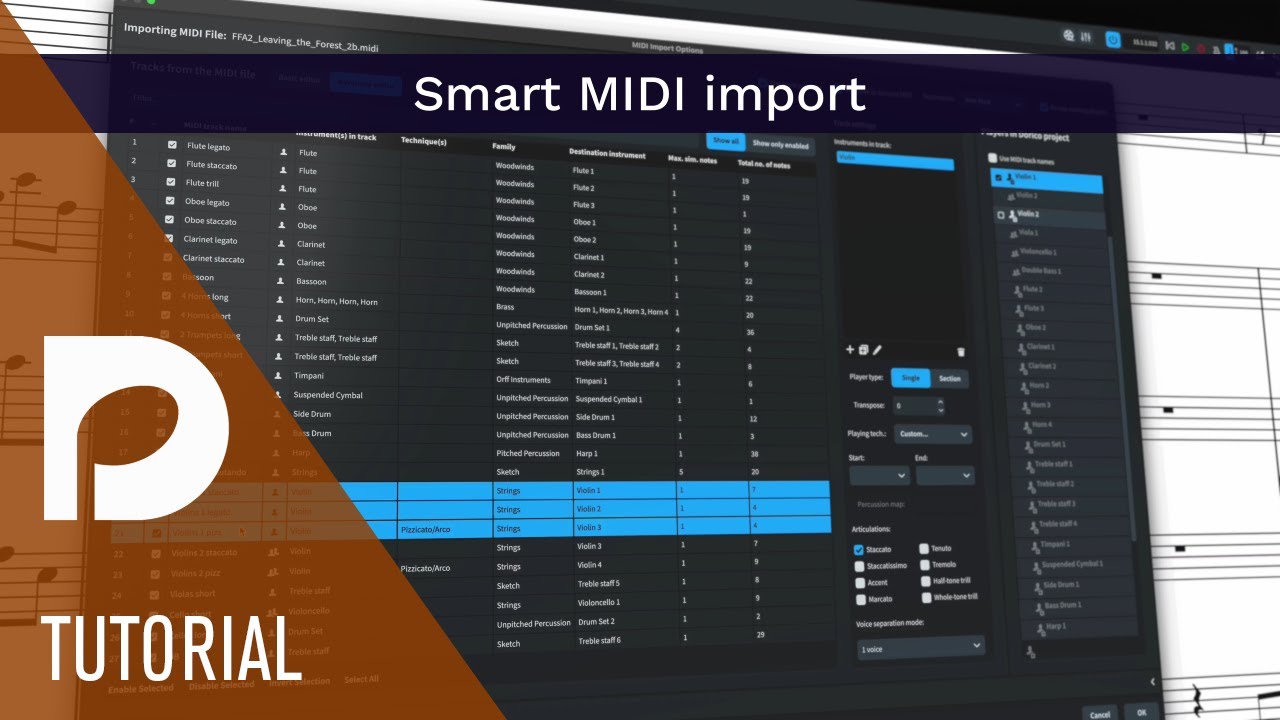
As far as I know, the Dorico team is really friendly, and I’m sure they’ll help you. In addition, Dorico is very efficient at handling MIDI imports, so Logic users should feel comfortable with it!
Cubase is great for building up structures: noting down some basic ideas and assembling them into the structure of a piece. It has aliases, and the arranger track to help with that. So I often start with Cubase and then move to Dorico.
But sometimes I start with Dorico instead, if there aren’t complex structural ideas to sort out first, and my ideas are already clear.
And, at the very end, I may move back to Cubase to get the best renders possible, using audio files exported from Dorico.
Yeah, good way to work, especially, as you said, if the structure is complicated and you need to quickly try out different versions.
Just curious, do you use the new Cubase Score Editor in that process, or is it straight to Dorico (via MIDI)?
I haven’t so far - I’ve been working on a big piece in Dorico for a long time!
I expect I will do in the future.
He was curious as to ‘which’ you would choose though - would you use the new score editor in C14 and export as a Dorico project, or, build up using MIDI only and export that into Dorico for notation needs.?
I would use a mix of the score and keyboard editors, and I would expect to export as a Dorico project in future.
In the film “Amadeus,” Mozart has that line about “scribbling and bibbling” — it’s all in his head and just needs being committed to paper. For some of us, a DAW is still very much a mystery; for others it’s very natural. Decades ago some would even compose on their tape recorders and could submit the tapes to the copyright office! I guess in the end it’s just a matter of using the tools with which we’re comfortable.
OT: Just a side comment to all on what’s intuitive. When driving a car, the right pedal makes the car go forward (assuming it is in drive), but in a small plane it moves the rudder turning the plane to the right! The throttle is where the gear selector would be in a car. Shoving that forward makes the plane go faster while it puts a car in park (with an extremely rapid deceleration)! What’s intuitive is largely based on the way we were taught how to use a certain system or a paradigm. If software follows a pattern or system that one can learn (and has a reasonable sense of logic; e.g. up arrows don’t move things down) it should be intuitive. If it’s rules are haphazard or seemingly random so that one has no reference, it would not be intuitive.
For me it depends on where the idea begins - audio or notation? I use Cubase for audio and Dorico for notation BUT I always have either pencil and paper or virtual music manuscript available on my tablet. So, for me, it’s a per-project situation. In my case I never produce audio from Dorico (nothing against it however) and sharing XML or MIDI sometimes works for me if I need a quick transfer, but usually I develop the work in both platforms. If it’s for a live ensemble I will use Dorico for the basic notation, print it out, then use pencil to orchestrate - eventually transferring my hand notation to Dorico. I’m sure many folks just do it all digitally, which is fine, but I do prefer the physicality of pencil and paper much of the time.

 I have a couple double throw switches in my house that I consider to be wrong as when both are in the “off” position the lights are on! I’ve learned to deal with it despite my OCD!
Music can have different seeds I believe, and will grow differently in different environments. I find the measurement aspect of notation like duration or pitch to have a sort of “snap to” effect in my thinking. It structures (good) but can be overbearing (bad) and destroy a sensitive idea until I can’t even find it anymore.
I also find that an early recording often only approximates what was felt and still developing. My answer is - I’m lightly sketching around the idea without disturbing it if I can, however I can.
My answer in the spirit of your question I think is notation. Dorico is where I seek to understand and capture, Its not the place of conception (and that part is hard to speak about  ) Notation is more like the nursery for ideas that have developed to a certain point - or back to my original metaphor, where seeds are planted and tended for me.
The DAW is a production tool for me. Anyone else like that?
Since most of my works are based on improvisations, I tend to compose by improvising in real time into Reason (which is what I use as a DAW) and then fashion that into an actual composition using a notation program (previously Finale, now Dorico). But sometimes I compose directly into a notation program. And in some cases I only used a DAW (for three works in which it wasn’t really ideal to try to notate the music, and thus left them as electronic works; one was for a piano that was run through a dual arpeggiator and trying to get that notated would be really hard if not impossible). Also, I was using Finale for a few years in the 90’s before I figured out how to hook up my early 90’s Ensoniq synth (which I still use; it’s next to me right now in fact) to my Mac via a MIDI interface, so all of my earliest works using notation software were input directly into Finale, but without a MIDI keyboard at all. And I didn’t use Reason until many years after starting with Finale, so I managed without a DAW for quite some time.
In other words, find what works for you and don’t be afraid to add software (eg, a DAW like Reason, Logic Pro, Cubase, etc) as needed. And prior to using Finale, I did everything at a piano (wherever I could scrounge one up, as in my university’s practice rooms or the basement of my dorm) with paper and pencil, and then used a fountain pen, transparencies and an electric eraser to create my scores. Notation software was a real game changer for me, though.
I’ve been a DAW user for decades as well; mostly Cubase and Ableton Live. I find Dorico to be a more straightforward way to compose; the music in your head gets written on “paper”, and you’re not necessarily distracted by or bothering with sample libraries, producing, mixing or any output at all, just the notation. I find it challenging not to be distracted by sound design, producing and mixing when composing in a DAW, but at the same time I enjoy the process of doing it all simultaneously.
I’d say typing in notes, note lengths and and velocities is generally no faster or slower than doing the same in a DAW’s edit window, but adding articulations is faster, and gives you a better overview than lanes of CC data. If you’re a skilled keyboard player you kind of have the same functionality for basic input of notes, dynamics and CCs/articulations, but I’m not a skilled keyboard player, so I couldn’t tell to what extent Dorico handles that compared to a regular sequencer.
As for your original question, I don’t think I would finalize a project that is intended to stay in the domain of sample libraries in Dorico, but rather finish it in a DAW, as a DAW gives access to many more convenient tools for producing and mixing. But there’s no reason to decide between one or the other; they compliment each other quite well.