That could be a good idea, but then I would not have the correct staff labeling, which works very well with string divisi otherwise.
And who knows, the problem might still occur when manually condensing different instruments.
That could be a good idea, but then I would not have the correct staff labeling, which works very well with string divisi otherwise.
And who knows, the problem might still occur when manually condensing different instruments.
Alright, I tried testing it out. It doesn’t work as you’d like.
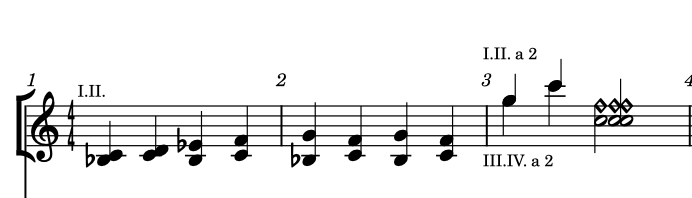
What I’ve pretty much come to the conclusion now is, “Condensing” is really only designed so far as to allow combining 2 players to a stave. I know they advertise stuff like having 4 horns on a staff, but I just did this experiment creating multiple violin sections and labeling them as desks, and I got this:
Which shows clearly that it’s only allowing up to a2 per stem. It has I, and II on the upstem, and III and IV on the downstem. With the harmonic, following this rule, it should still show 2 sets (not 3, so that’s not making any sense at all considering I have it on 4 parts), so as you pointed out before, harmonics are not handled by the condensing system correctly.
Even so, unless there’s a setting I couldn’t find, ideally bar 3 of my screenshot should have just said “a4” and shown a unison line.
Made a quick second test where I tried it as “solo” players rather than section players, and you can see again that it’s combining 2 players to a stem, so again, an a4 unison at the end produces a double note.
I’m going to return to my suggestion that if you have significant sections in unison, then you should approach it more traditionally and engage the unison function. And if they really are quite distinct, then you should make them separate “players”, and NOT condense them (or at least, don’t condense more than 2 to a stave, which would still reduce verticality by half).
It seems the issue is that you want each desk to have their own separate part so they don’t get stuck with all the verticality of seeing the many divisi parts on the same page. If there’s enough unison passages though, then they will still compress down to a single stave for those passages. And if you have varying combinations of unisons (like desks 1+2 in unison and desks 3+4 in unison) then that would be a divisi change which only shows 2 staves on the part.
However, if unison passages are generally infrequent, then going with them as actually distinct, separate players with unique parts, then just condense the score so far as 2 desks per staff.
The fact that you’ve been approaching this so far as divisi rather than many solo parts would mean that the player parts were always going to have the large vertical set of staves anyways. Using the unison will actually be cleaner on the part than what you’re doing currently, as the condensing might improve readability on the score, but it will still be a nightmare of the performers with the huge number of page turns, few bars per page, and constantly needing to make their eyes skip over their colleagues staves.
Indeed the whole thing is somewhat related to one of the items in my “Dorico 5 most wanted list” which is the fact that there is no choice to have notes amalgamate at a manual condensing change. It’s either shared stem or shared staff. This makes handling 8 horns more difficult for example, but in the case of of chords and harmonics, I see now that one is really stuck! The Dorico team is well aware of the improvements needed in the area of condensing. This particular one is likely a nightmare to program, so we’ll have to be patient.
Thanks for having investigated on your side!
It seems you took a different approach than mine right a the beginning, by choosing individual players instead of creating first a string divisi, which leads to the a2, a4 problem you’re pointing.
On my side, condensing divisi works well, beside two things : 1) glissandi line that disappear 2) chords and artificial harmonics that stack instead of being condensed when I use manual condensing.
So it seems there’s a bug with manual condensing that don’t take into account preferences regarding condensing unisons. If that bug was fixed, I think everything would work fine (beside gliss .line disappearing, which is another problem that was pointed out in 2019 I think Glissando is lost during condensing)
Regarding individual part, I will create one part per desk, which is quite easy and convenient (both for the engraver and the performer). There won’t be multiple staves in these parts.
It seems though Dorico is able to amalgamate unisons (in one voice) with strings divisis. (Unless I misunderstood you with the 8-horn example)
It fails only with chords and artificial harmonics (which are considered as chord I believe since there is two notes per staff)
Yeah, I wanted to try a different approach then you specifically to see if a different method would yield better results. It, uh, didn’t. LOL
I’m curious how you’re getting separate layouts for each divisi stave though? When I tried doing it with divisi, I could only see adding the “section” to a layout, I didn’t see any option for grabbing individual divisi parts. Which, I think makes sense considering that divisi are treated as alterations within a project, and aren’t defined in setup. But you’re saying you’re able to do it? I’m curious how you’re pulling that off.
I juste need to hide the staves I don’t need. Once the formatting is done for one desk, I can duplicate the part and substitute one staff for the other.
Hmmm this may be a bit of a janky suggestion then, but this would approach how I would have done it in Finale (which lacks Dorico’s divisi functionality).
If you did each one as a separate player, you could still force “manual staff visibility” to hide staves which are redundant (unisons) and just mark in text the “a2” or “a6” combo at any given unison point. It should look correct, as you’re not actually condensing anything, and it won’t have the toggling of divisi staves as I’d suggested before - and your layouts will all be specifically just their one staff each, so you won’t need to fuss on the parts as much with hiding staves either.
This is something I considered, but it increases the risk of doing mistakes in individual parts + it takes way more time. What I will do is to duplicate the file to work directly on the score, without affecting individual parts (by deleting the divisi where I can). I need also to replace glissando lines with horizontal lines to workaround the missing gliss. lines occurring in the condensed score.
When one is trying to do something outside the box, this is to be expected: it takes time and extra work.
As I just said, this would not completely fix the original problem, since there is still a bug with missing glissandos in condensed mode. One might consider doing two separate files a better option.
Any news regarding condensing double stops and harmoncis on strings and glissandi going missing? Problem is still there 
Things should be in a generally much better state with divisi and condensing now than they were in June of last year, as December’s 5.1 update included a lot of fixes and improvements in this area. If you are still having a specific problem, please cut your project down to the smallest chunk that still exhibits the problem and attach it here so we can take a look and see what might be going on.
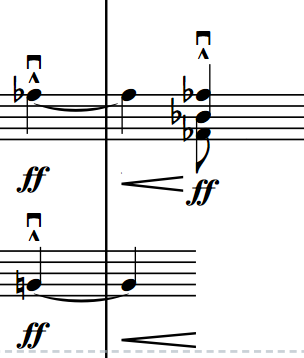
Dear @dspreadbury , it seems the problem related to condensing div. strings remain when artificial harmonics and double stops are used. (image without staff labe are Violins 1-6 in one staff and 7-12 in the other)


Hi @dspreadbury ,
Here’s a case where two violins play copy-and-pasted unison until measure 18, but stop being notated in unison on the last beat of bar 4.
(Version 5.1.51.2153)
I’ll be curious to know what you find!
Cheers,
Doug
Put a condensing change in the middle of bar 19 (the E). Just tick the violins’ check-box and do nothing else. This will tell Dorico that a new “phrase” starts there.
Rereading the documentation (see Phrases), I see why this happens:
All of the rests in bars 10–11 are spanned by a diminuendo hairpin, which negates the separating effect of the rests. So Dorico is treating everything from the beat before bar 4 to the actual split in bar 18 as one “phrase” for condensing.
Mark, thank you! It’s a bit hilarious because that decrescendo was leftover from an earlier version of the arrangement; I just removed it and that solved it.
Claude, thank you too!
I am looking for a solution when you have to write double stop in strings in condesning scores.
I use two voices to do that, but that doesn’t work with condensing.
Maybe you could tell me a solution if you find any to reproduce this.
Please do not double-post; it wastes people’s time, particularly that of the Dorico Development Team that read all posts.