I’m confused about the behavior of the Asio guard. I watch the performance meter and sometimes the Asio guard seems to do nothing, although it is activated. The Asio meter shows zero activity like in the screenshot. It should do his job, because the performance meter is very high and there are already some dropouts .
In other cases the Asio meter indicates an activity, but when I play the same project again, it might be that the Asio meter doesn’t show any activity.
Sometimes the performance meter in Cubase shows a very high level of resources usage, but the computer system shows a low CPU usage. How is it possible ?

ASIIO Guard/Performance Meter is (somewhat) explained here.
The performance meter doesn’t show CPU usage, it is some Cubase internal performance metrics, which probably depend on several factors.
Cubase has some know issues with projects that use many (especially stacked) groups and long plugin chains. So your system can playback maybe dozens of instrument tracks fine, gut if you route those track so several buses, put a lot of plugins on those, then also put a lot of plugins on the master bus, ASIO load can get quite high even if the overall CPU usage isn’t.
If the ASIO guard is low, but the real time/peak is high, it could mean that you have some very demanding instruments running that are all record armed.
It all depends on the project.
It all depends on the project in question.
From the looks of the meter, are you sure you didn’t turn off ASIO Guard altogether? That’s basically what the system looks like when ASIO Guard is off.. Without it, the CPU is constantly being hammered.
No, the ASIO guard was on in this case.
There are no busses involved. I used the Steinberg plugin Flux , which is part of HalionSonic , with just one track. It maybe a very demanding plugin, but why is ASIO guard sleeping? I don’t understand, how there can be dropouts and a high ASIO load, if the system CPU usage is low.
If it was not enabled, you would not see it in the monitor panel.
If you have monitoring enabled on a track, I believe ASIO guard turns off by default. Thus the metering dropping to 0.
exactly, if you only have one instrument track in your project, and you recored/monitor-enable it, the track gets moved from the ASIO guard path to the realtime path, leaving nothing in ASIO guard.
The peak reading on mine is 50% without a project being loaded
I thought when there isn’t a project this would be almost zero

Here’s a thing, in Cubase 13 pro it’s the same as yours where the indicators are virtually visible but, in Cubase 14 pro the real time and peak are on 50 %
I don’t have C13 installed anymore, but I recall the same thing.
On MacOS I’ve seen varied, and unidentified, behavior from APM even from one empty project to another.
C14Pro.0.20 empty project APM doesn’t change in the slightest when I open N14.0.20, and both actually report different measurements but using the same project/audio settings. So these seem process dependent, not system dependent:
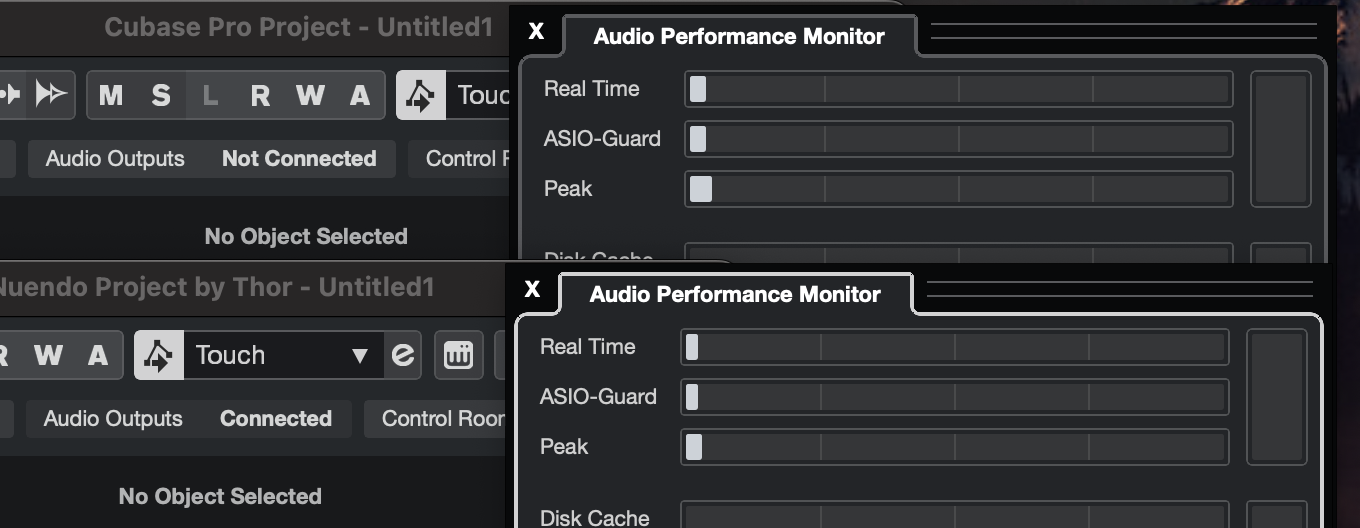
I actually couldn’t find any substantiative data regarding what exactly is being measured, so I’ve just been ignoring it. I’m sure I’ve missed something, but I find it interesting that with 2 empty projects, Cubendo versions give me different measurements independent of each other, and without affecting each other.
EDIT: It may be affected by how complex CR is configured as well.
Thanks, I’ll have another look tomorrow. I may have to use Cubase 13. bit of a waist of money really
Is there an actual issue with audio though? I’ve seen several references to APM “spiking” but without any impact to functionality; almost as if it was just a graphical glitch that didn’t manifest itself anywhere.
I’ve just nipped back to have a look and it’s because I have an insert the Control Room headphones out. It’s a Steven Slate VSX plug in. When i bypass the Audio performance meter go back to virtually nothing. Thanks for the help guys.
For me it’s still not clear, what ASIO guard is good for. If I record enable a track, the ASIO guard is turned off. Does it mean that ASIO guard is only a help during the playback- only process? But the ASIO guard would be more helpful during the recording process, not so much during the playback process. During recording one must have low latency, that means a small audio buffer. During playback -only I can increase the audio buffer, which would have the same effect like the ASIO guard.
I’m only speaking for myself…
In the days when I recorded myself, I would have the bare minimum of tracks playing, and as few FX plugins as possible. This enabled me to get an extremely low latency performance.
Once I was happy with my recording, then I would go doolally with all the FX plugins, the backing instruments, sample libraries, etc.
That was when ASIO Guard came into it’s own.
Are, you recording with plug-in’s?
Definitely, best practice.
I use a MOTU AVB device, which has onboard compression, equalisation and filtering, and the best way, is to use it like an old-school console, whereby you record stems and mix those later, using effects (I use UAD for mixing).
I’m not sure how the ASIO guard works, If i use the compensation button at the bottom left of the project screen it makes the sync worse.