Chord popover shift-Q does not support entering drop-voicing for the purpose of creating the correct specific voicing-inversion. This is a vote to add such. Drop voicing is very, incredibly, important on certain instruments such as guitar and extended harmony ensemble genres (ie, jazz band).
Maybe there is a way to manually do this with the Note Tool shift-I ? But, something that isn’t too confusing either.
Don’t ask me to explain drop voicing concisely. Mozart himself would say it is too trivial to explain. It seems jazzers are not good at explaining it either even in their jazz books. You voice the chord with desired inversion, usually an extended 4+ pitch chord. Then you take the n-th most note and drop it to the bottom, and call the chord “drop-nth voiced”. For example, in an inversion voicing which results in seconds at the top, the 2nd-to-the-topmost note is dropped to a lower inner voice to create more interval space around the topmost chord tone. Or on guitar due to fingering or to avoid unwanted doublings and to use an open bass string, a 3rd-from-the-topmost note is dropped to the bass (but not because of specifically being an inversion; it is because it is drop-voiced, and more specific than an inversion which leaves inner voices undescribed). Am I confused? Maybe, but so is everyone else, even though it is incredibly important to write and play these correctly.
What popover text would be used to enter drop-voices? I don’t know, maybe it would be appended to the chord name.
This would also significantly improve realism in playback for the Chords instrument. (Forget iRealPro. Play it in iRealDorico.)
[EDIT: I see that you are referring to Chord symbols…, so maybe my post is not what you needed, sorry.]
Maybe I am old-school or don’t know a better workflow, but you certainly considered to do this with filter and octave transposition (also recordable as macro)?:
That is true, although Drop voicings get more detailed than this, whether 2nd or 3rd or 4th note, and also including dropping pairs of notes down (“drop 2&3” or “drop 2&4”). Essentially drops are ways of more precisely specifying the order of pitches, top-down, compared to a generic (200 year-old) chord symbol that only specifies the bass note. I am not fully versed in drop voicing and I don’t much like the term either, considering that it introduces even more digits into describing chords and with a reverse counting methodology (counting from the top, vs. intervals which count from the bottom); like most jazz it is not well thought out methodology.
A macro to do what you recorded, could be a method for specific simple drop voicings, when they are selectable by the filter type. In other situations the 2nd-most note is changed not by octave transposition but to a different chord tone to make the “open voicing”.
An alternative might be entering the entire stack using the Note tool, if the Shift-I popover allowed entering sonorities from a bass note, i.e. “a,7,4,6,5” (arbitrarily making something up to express the idea) but making chords using the Note tool is pretty cumbersome and isn’t what the Chords Playback uses either.
For what I know, the Chord Symbols specifies the notes of the chords and their bass (that corresponds to the name of the chord if not specified, or should be otherwise be written explicitly as inversion like C/E for “e,g,c” chord, beginning from below) for the whole ensemble.
The drop techniques are only used by the comping instruments to achieve a more pleasant sonority of their parts, but it has nothing to do with the nature of the chord or its real bass (even if only imagined in some rootless voicing). If you play a drop 2 on piano comping for example, on a Dm7 chord, the lowest note of the piano will be an “a”, but hopefully the bass player will play somewhere a lower “d”, otherwise the chord will sound as an inversion (Dm7/A) and not only as drop.
Hi. I’m reading this thread and wondering. Is this only for playback purposes, or should there be some kind of indication added to the chords symbols (something I’ve never seen on jazz charts, but I admit my knowledge about those are fairly limited) ?
My understanding, if it’s for playback only, is that Dorico will play whatever voicing you will use to enter the chord, providing you use a MIDI keyboard (and not your computer keyboard). There is a technique even to specify that you might have a specific bass below the chord, and all… But maybe I understood this all wrong.
Drop voicing is not written as a notation on a jazz standard chart but immediately a guitarist will add those pencil notes to their own chart for playing the tune (well, if/when they need to, if they don’t just fall back on automatic finger memory). Jazz itself is rarely notated ‘fully’ or ‘properly’ so using their charts as a definitive ledger is not solid footing. Jazz transcriptions which analyze voicings, i.e. musicology stuff, will notate these as drop voicings, if the transcription is trying to be fully detailed about the realization, either for analysis, or for legitimately reproducing the performance later.
Well, this statement seems to reinforce the concept that drop voicing, in general is part of the personal interpretation of the performing musician, and that should therefore be left at the player discretion.
In case of transcription fidelity etc., I think that the drops can be very well be visualised in the actual notes or tablature (where you can be veeery specific not only about drops but also rhythm, doublings, fingering, etc…).
So write down the detailed notes that you want, and Dorico will play them back. If you are looking for exact playback of what you want, I would not look for some automatism, prone to inaccuracy or “worst-effort simulation” as an hypothetically drop notation would do)
I was referring to comping players that use drop voicing, and often comping is improvised. Of course the texture and voicing for other not improvising instruments should be accurately be notated as desired in the music.
No: this is called Improvisation, and it is an Art and actually is the heart of Jazz!
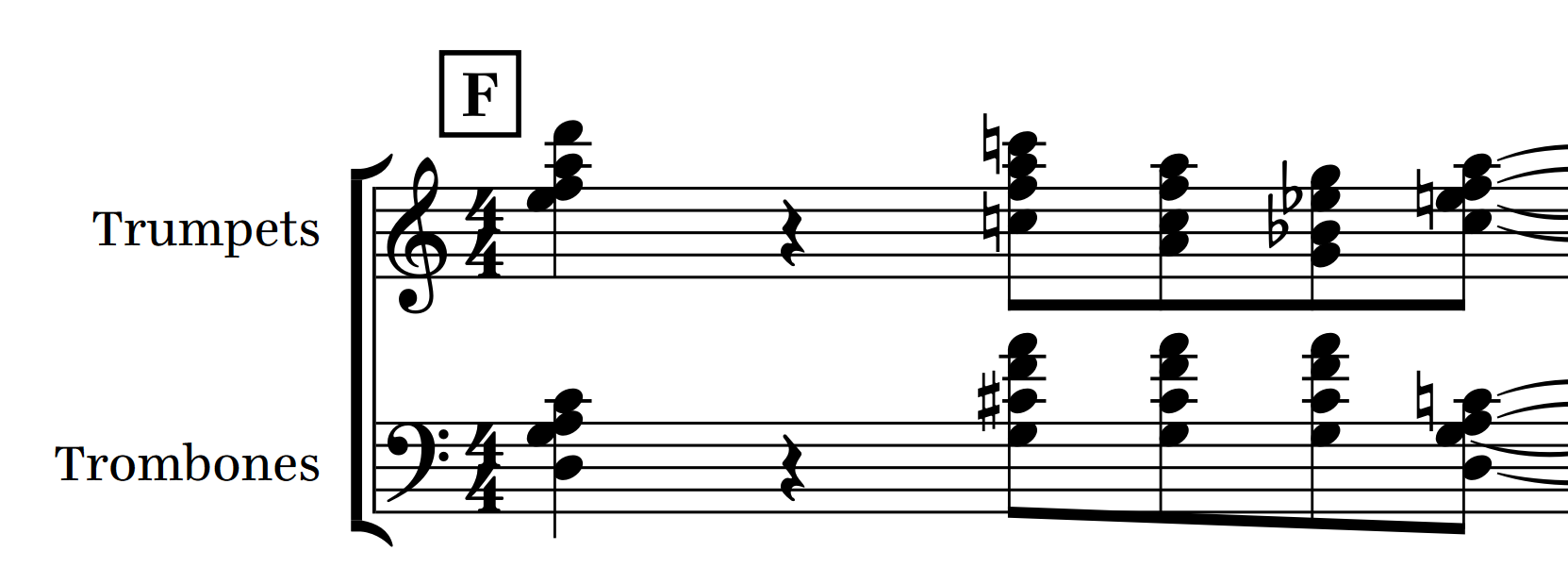
Close. Upper Structure Triads (UST) aren’t usually drop voicings but voicings incorporating the extensions of the chords to form triads that vary from the fundamental chord. In the example below Thad Jones is using F and Eb triads in the trumpets over the A7 chord in the Trombones:
Wow, it’s now clear you have never spent any amount of time around jazz musicians ever, who are consistently the most studied and most brilliant musicians I know. The “lazy” trope is also racist. I’m done here as well.
Hmm, I don’t think you’ve had much to do with the jazz world. The amount of theory a player needs to absorb (and make intuitive) is very high. I found it more challenging than classical harmony personally, but for sure it is at least the same order of complexity.
But it will only add intervals in relation to that selected note, not, as the OP intends, stack notes on top of each other one by one. So, to clarify: with the interval popover you can type “5,3” and it will add a third and a fifth above the selected note. What the OP needs, however, is a fifth and then the third (relative to the bass note) should be above that fifth – but that would be an 11 in the actual interval from the selected note.
Couldn’t you just type “5,10”? (I think you mean a 10th rather than a 11th.) And you can do that for a whole melody line at a time, too.
(As an aside, it’s a while since I did my music degree but I think these sorts of voicings usually work down from the melody line rather than up from a bass note, but maybe I’m wrong. The shift-I popover can do that too, if you type in negative numbers.)
I don’t think chord voicings are necessary left to the player because they can do it more correctly. I think it’s sometimes (definitely not always) left to the guitarists and pianists because there is a certain magic that occurs when a great comping player interacts with an improvising soloist in real time that cannot be captured in written notation. For virtually any professional jazz composer I know, it is entirely within the realm of their craft to be able to write specific voicings. They choose not to for intelligent musical reasons. And when they do need to specify voicings, they do that as well.
I fully agree with many of the responses above that some of the comments about laziness and lack of knowledge are at minimum a misunderstanding of the extraordinary deep harmonic knowledge of typical jazz musicians.
I’ll tackle the second part first. No one in jazz uses tab, at least not from middle school on. It’s not necessary. I don’t write fingerings in bass parts either. Never in my entire professional career have I needed to write tab, nor encountered it in written parts, so that’s a non-starter. I don’t teach it, nor do I care at all about it. The tab feature could be completely removed from Dorico without affecting my performing, arranging, or teaching career whatsoever.
I teach drop-2 voicings as part of my masters pedagogy class so students can learn to rearrange and voice stuff on the fly for student ensembles, as almost all of them will end up teaching at least at some level. In my comp & arranging class this is week 1-2 level stuff that I honestly assume is review. This obviously also applies to non-guitarists as well.
Writing a guitar part with simple drop-2 voicings should be more or less a basic exercise by the time students reach me at a collegiate level, and that includes drummers and vocalists too. This is not difficult for anyone that has internalized harmony to the point that this is automatic. The best jazz musicians reach this level even before college. I taught a saxophone lesson today to a student that is a junior in high school, and she is getting close to that level. She easily can take a II-V pattern I give her through the keys at a lesson. I’m currently writing an arrangement that will be played at Carnegie Hall this summer by some of the best high school students in the US, and I have no intention of writing tab in the guitar part, as that would be an insult to whatever high school kid has to play it. The harmonic devices being discussed in this thread are not difficult to those who are willing to put in the “time, patience, and intelligent work.” (Marcel Moyse)
We do the same thing with bowed strings all the time and no one bats an eye. No one marks positions or puts string indicators on every note in violin music. And if we need to specify a passage is played on the G-string, for example, we can notate that for that specific passage.
Same applies to guitar. Just give me the notes and trust that I know what to do with the instrument.
It is obvious that you have no background in professional music business.
In my almost 40-year career as a professional guitarist, I have never been presented with tablature as notation. If a guitarist cannot produce sensible fingerings from standard notation, a change of profession is called for. And if more precise indications are required, the necessary symbols exist in standard notation.
Tablature is a stopgap for guitarists who have never learned to read music.
And nobody has ever told me which voicings to use. An arranger will say “your chords are too dense” or “don’t get in the way of the piano”, but never “use drop2 voicings”. It’s my job to decide that.
If you look at a selection of jazz charts, for the guitarist you will see chord symbols (most of the time), some written-out lines or sections, and some indications of rhythms.
Ditto for keys.
The expectation is that the players will voice chords themselves.
There’s absolutely no need to write out explicit chords and it wouldn’t help.
As far as Dorico goes, if one wants to specify the notes a (VST) guitarist plays, one should take the time to write out the notes rather than expecting the Development Team to suspend work on more important (generally useful) features and clutter up the written score with indications a live performer will never use.