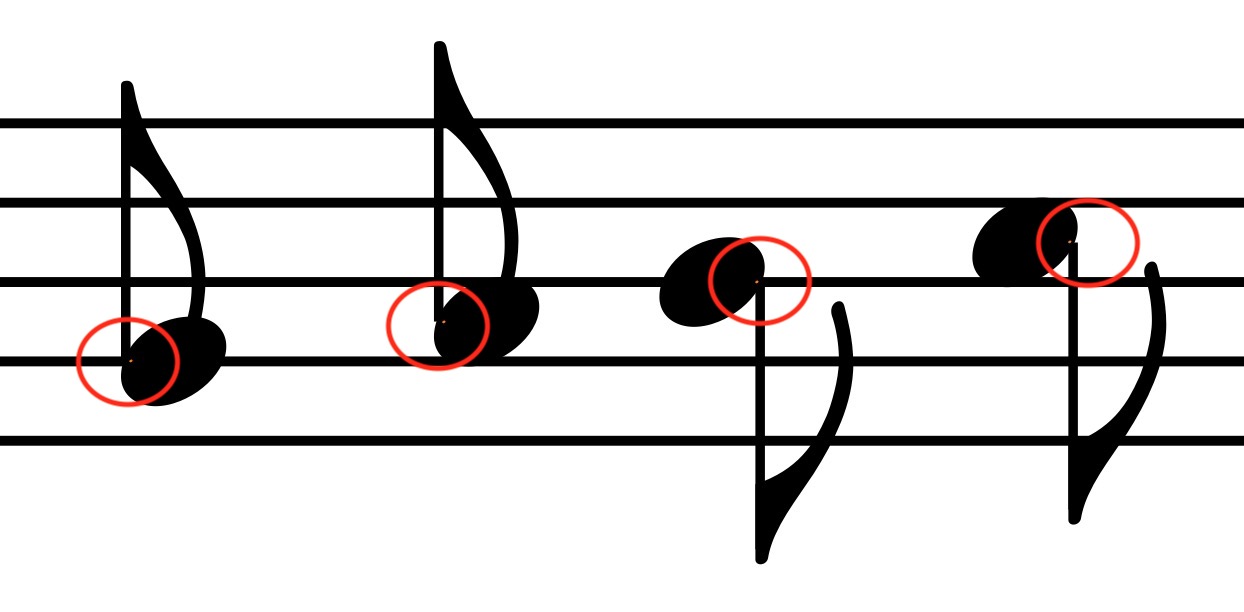
Moving notehead to left or right without moving stem?

Hello,

Can’t find the answer in the manual.
How to move notehead only to left or right wihtout moving the stem.

I tried stem adjustment in engrave but no succes.

Kind regards,
Johan

Hi Johan, what is it you’re trying to achieve, do you have an extract of manuscript you can share that’s the sort of thing you’re after? It may be there’s a different but better way to achieve what you want but without knowing your intentions it’s hard to say.

If this what you are trying to achieve, one way is to go into Engrave mode, select the stem and drag the edit box on the end of the stem up or down to the opposite side of the notehead. You can select more than one at a time and drag them together.

Alternatively (also in Engrave mode), select the notehead(s), open the Properties panel and under Notes and Rests you will find Stem adj. . The default distance from the notehead to the end of the stem seems to be 3 spaces, or thereabouts. A value of -6 or -6.5 will flip the stem vertically while keeping it on the same side of the notehead and maintaining much the same length as before.

This method seems to work well enough for notes without tails (half notes and quarter notes). Beamed groups of eighths, sixteenths, etc. seem to only work by dragging the beam or by changing Start Y offset and End Y offset under Beaming in the Properties panel (again, select the noteheads, not the beam). On individual (non-beamed) notes with a tail (eighths, sixteenths, etc.), the tail will not flip with the stem, so it looks like in the screenshot. As Dorico is at the moment, I doubt that there is a “native” way of changing the tail orientation and probably will not be for quite some time (if ever) - my guess is that the priority would not be as high as for more “standard” notational features.

Here is a partial solution for non-beamed individual tailed notes.

In Write mode, select the note, add an interval and then use alt-up/down arrow to move the new notehead to make a unison.

In Engrave mode, select only the notehead on the “correct” side of the stem. In Properties panel > Common > Custom scale, enter the value of 1. The selected notehead will effectively disappear. Because it has greatly decreased in size but it still attached to the stem, it has “moved” closer to the stem and is now obscured by the normal-size notehead.

For the notes that are on a space, there is a very small gap between the notehead and the start of the stem. This is because the placement of the stem is based on there being two notes attached to it, and the other note, if it was still normal size, would cover up that gap. At normal viewing size and when printed, the gap might not be noticeable unless you know to look for it. For notes on a line, including on leger lines, the line covers the gap.

There is no way of flipping the tail from the right-hand side of the stem to the left to give a complete mirror image of a “normal” note. The tail always stays attached on the right-hand side of the stem.

To clear the tail from the notehead, you can drag the end of the stem in Engrave mode, as I described in the previous post.

1

Thank you all, I will try everything tomorrow. Kind regards, Johan

Hello,

Thanks about the unison trick.
I also used a vertical line.
See example. (used for education)
Find and correct wrong notes.
Kind regards,

Johan

I’m now playing with notehead sets.
Maybe even a better solution for my simple needs.

Kind regards, Johan

1 Like

You could create a new set of Noteheads and move the stem anchor positions to the opposite sides. Then select that notehead set where you need it.

2 Likes

Hello benwiggy,

That’s what I tried and it worked like charm.

Hello, this is an old post, and I’m wondering whether there’s a way to move a note “on the other side of the stem” easily in Dorico. The trick of a ghost small note is of course far from ideal for many reasons, and there are many reasons why one may want a note on the other side – for instance, in my case, to write a string bichord where one note is ordinary and another one is an artificial harmonic: distinguish them on two sides of the stem makes the notation clearer.

Best,

Daniele

You can add a prime interval to a chord, just like you can do with other intervals.

A few different methods:

  • in input mode (caret visible), move the caret to the chord where you want to add the note, activate Chord (”quord”) mode with Q and enter the note, with a letter or playing on your Midi kbd
  • Select the note to be duplicated, type shift-i, 1, enter. This will add a prime to the chord.

There may be even other possibilities.

2 Likes

Hello PjotrB, Not sure what you mean by “add a prime interval”: I just want to move the notehead on the other side of the note, no duplication of anything required…

Am I missing something in your reply?

Sorry…

Daniele

First of all, maybe I should’ve used unison instead of prime, which may be too much my own Dutch terminology for it.
I was under the impression you wanted two noteheads in unison next to each other, but I probably read your question too hastily. If you just want a notehead on the ‘wrong’/other side of the stem, there are several useful suggestions in the thread above.
AFAIK, there’s no ‘simple’ way of doing it, i.e. no instruction to do this directly. You’ll need a workaround anyway. It’s not standard notation, after all.

It’s always helpful if you could show what you like to achieve, with a screenshot, or even a hand-drawn sketch. Harmonics are a complex part of music notation with lots of different approaches and traditions, sometimes quite idiosyncratic.

2 Likes

Thank you Pjotr. Here’s one, among many:

The positioning of the harmonics is wrong. What you see is an artificial harmonic C-F plus a single note F, but no string player would be able to decypher it in this form. What if I want C-F artificial harmonic, but then another F on another string?

I think you would use two voices, like this…
harm

(That said, I don’t think cellists can stretch to play this)

1 Like

In that case, it’s better to notate the other F (the regular one on the other string) in a separate voice:

In this case, I entered the F first in the up-stem-voice. Then I did shift-V to create the second (down-stem) voice, then entered the C, and adjusted several settings in the properties panel below to show the artificial harmonic.
(Note that if you already have a second voice in use elsewhere, you don’t need to create an extra voice. Don’t do shift-V again, just type V to switch between the existing voices.)

OT, but BTW, as a cellist myself, I must ask: is this intended for a cello alone, or a section in an orchestra? For a solo cello, this is totally impossible as a double stop, and a orchestra section would have no choice but to play it divisi (something they’d do anyway with whatever double stop, unless specifically asked to play non div.).
The artificial harmonic is played with a thumb on the fixed lower note, and a 3rd (=ring) finger lightly touching the same string a fourth above. This harmonic is playable on both C or G strings (but will sound better on the G). But while playing it, there is no way to reach the F on a neighbouring string. It’s in a different position.

(Ninja’d by Janus :hugs: )

2 Likes

Hi both, you got me :), that was an in-vitro example where I moved things up and down I tried to see what didn’t work. My actual example was lost, I had rewritten it since I couldn’t make it work. Still, there are many ways in which which you could have an artificial harmonic on and perhaps a natural harmonic on another string, and I like to notate them on two separate portions of the stem. Having two voices is a workaround but honestly isn’t consistent with how I notate the rest of it. Here’s a simpler one, for instance

I would love to move the harmonic on the other side, so that it is very clear that two things are to be produced (the open C and the harmonic).

Thanks so much for your help in any case. I’ll go with the new voice in the future. Still, I really hope that Dorico will let us customize things more. Moving noteheads isn’t a crime. With Finale gone, I feel that a lot of things are missing – a lot. Notation is semantic, of course, and I appreciate so much of the philosophy behind Dorico, but I believe that notation is also freedom which if you squeeze too much, you kind lose the energy and happiness of it.

My two cents, of course, as someone who struggles not to lose this happiness in this transition…

I don’t think this is correct either.

Personally, I would put the low C into a downstem voice. The 3rd partial on the A is still a big stretch for cellists (and would sound an E4 an octave higher). So the shadow G makes no sense. What is it’s purpose?

Could that be an input cursor for mouse note entry?

Assuming your last example is from the ‘real’ composition, I would advise to use two voices even more, because this harmonic might indicate several combinations on both the open C string and on the stopped A on the G string.

To avoid confusion, I’d write this:

to avoid confusion with

which is unplayable, at least with the node indicated. I had to fake this last example by manually assigning a diamond notehead, because Dorico, as yet, doesn’t do nodes higher than the 1st (despite there being a option for it in the properties panel).

All advanced string players do understand notation in more than one voice. Anyone who has ever looked at a Bach solo Partita or Suite (and that’s literally every string player) is familiar with it.

Small note (pun not even intended): I assume the grey G in you example is just a ghost note from your input session? Or is it something you want to have printed as well?

Oh, and one more technicality: the artificial touch-fifth harmonic on the A is possible, but cellists with small hands may not make it. Don’t expect anyone to also (reliably) stop any note on a neighbouring string, because the left hand is fully stretched there. The open C is OK, though.

1 Like