I’m not trying to spin anything, and I can confirm that I’ve read previously that this is unfinished functionality that will be improved in future. All I’m saying is that it’s working as the programmers designed it to work, so it’s not a bug.
That would suffice instead of all this long discussion!
I would recommend to add this as a warning somewhere in the percussion kit screen! Like “important note - percussion kit voices behave differently than normal voices, please read details here…” And also in the notation options / rest padding, same notice.
I’m merely a user. I have no more power than you do to fix this.
I’m trying to explain to you how to work around the functionality as it currently stands. If you don’t want my help, fine.
I like the way Dorico’s percussion mapping is done. It did take some time to get use to, and there are still things I think it could do better. However, the team has never made it seem that percussion is done. They know there is still some more work to do.
As someone who has dealt with percussion notation as my main focus for right around 30 years, I can tell you that Dorico is far superior to the other programs I have used (Finale and Sibelius) for percussion notation. I think it will just take time for some (including myself) to wrap their minds around this new way (which is not a bad thing).
I would also add that it is important to remember that Dorico is not a DAW. It is a notation program designed for people to write music, and get a reasonable playback. The method Dorico uses to achieve this in the percussion world is to use Instrument+Technique as opposed to a MIDI number/pitch. I remember in the old days working with Finale that having a percussion mapping not the same as mine meant I was having to input music all over again. This was a nightmare. With Dorico, it doesn’t matter what library you are using… if C4 is snare drum in your library and D#3 in mine, we can still share a file and hear close to what the music should sound like (provided we both have good percussion maps setup for our sounds). I know this is ‘different’ than what many people are use to, and as I said before, still a few minor limitations. But the idea and the direction I think it actually pretty amazing and will prove to be way better in the long run. When working with Dorico it is best not to think “Sibelius does it this way, why doesn’t Dorico?”, or “Dorico should follow what Finale does here”. It is a whole new way of thinking about percussion notation and percussion mappings, and it has many advantages with few disadvantages. Currently the only real disadvantage I see is the amount of time on the front end setting up your percussion map, and ensuring in the kit editor all of your techniques are in order. After having done some 15-20 percussion maps already, I am a lot faster, and seeing more consistent results as I am recognizing where I make mistakes in the process.
@Theoretical - the team is very aware of the rest issue with percussion, and they are working on it. This has been discussed many times over. I agree that there are issues with the way rests are handled and am also waiting for this to be fixed. The rest issue is certainly a disadvantage at this point.
I’ve just watched an excerpt of the video you posted. If I set the options exactly as Anthony mentions, I get the result that I believe you’re expecting.
Is it possible that you’ve overlooked the “Drum set” checkbox in the top right corner of the Edit Percussion Kit dialog? It’s not on by default if you Create Empty Kit, but it is on by default if you start with one of the pre-made Drum Sets.
If you don’t have it turned on then it doesn’t make any difference what you tell Drum sets to do in Notation Options, because you’re not working with a Drum set.
Yes, and it’s logical and makes sense! I realised that as I was going through the modern drummer. I started the other way around, which is more natural, but now if I look from the notation perspective, I can map to whatever drummkit by just changing the midi numbers (in XML, see below).
So now I understand that it’s very important to have the left side of the kit polished (Robby here I’d need your help), and then it becomes generic. Mapping it to any other drumset should not be a big deal. In fact, it should be easy to use all Komplete 12 drum kits with the library I’ve created here (in the table you can see mappings for studio drummer).
See, the experience I’m sharing here should be valuable, because I’ve never used neither Sibelius nor Finale (I did use some MuseScore though, but its usability is really low bar to clear, unfortunattely). So my expectations are just “common sense” and intuition.
Indeed! A simple list of defined instruments ad playing techniques and ability to map that to a midi note by entering a number!
That’s how it should be, not mapping a number to two entities (and don’t you forget to click the apply button ). And worse, in the UI, if you want to remap instrument/technique to another number, YOU NEED TO DO BOTH STEPS ON ANOTHER NUMBER, meaning you are basically at square one. Thanks god it can be remapped efficiently in XML!
Personally, I’m fine with a grid for now. Still, I would suggest the team to consider adding the remarks I mentioned in the above posts to the UI, as currently the whole experience is confusing. If “this question pops up over and over again”, well, address the core reason / source of the question, right?
I hope we get to the point where just the final touch could be done in a DAW. I have, let’s call it “analytical approach to music”, that’s why I want to learn to compose in Dorico and do most of the stuff in it! Perhaps not today, but in the future.
@Theoretical - can you add that file here. I do think you are getting an absurd amount of rests which makes me think you have something selected which you should not.
Ohhhhh… thinking back to an earlier post of yours… you made a comment about a playing technique applying to all instruments in that voice (which I don’t think is 100% true in all cases). Do you have every instrument in its own voice by chance?
Just the kick is still in its own voice and gets the rests. I suppose that’s because it’s down stem voice?
So I guess I got almost everything about voices in percussion kits wrong
But now this kit is getting usable! Oh right, but it might break playing techniques, as those are now applied across all instruments in a vocie This IS a design problem!
Ok… I am glad we are working things out. The bass drum having rest is certainly a common thing when you have the bass drum in its own voice. As a percussionist, your example B is very easy to read, and understand. The rests do not add a layer of complication for the player.
I am glad things are slowly moving in the correct direction for you.
I think the playing techniques part won’t matter, UNLESS you have assigned the same playing technique to numerous instruments. If you used the word “buzz” on the snare drum, cymbal, hi-hat, and tom 1 and all of those exist in the same measure… you might have that buzz technique apply to all instruments. But aside from that, it shouldn’t be an issue, because of the instrument+technique. Seeing “crash” above the kit will only affect the instrument you have crash assigned to. As long as “crash” is not part of the snare drum, there will be no issue.
There is also another thing you… it appears you have a lot of tied notes. You can remove that…
Under Notation options (cmnd+shift+N) under percussion:
Bell and Tip are common for all cymbals. Also choke. This IS a problem
The only alternative I see at the moment would be to use noteheads for all playing techniques, but that would be nonstandard, wouldn’t it?
Yeah thanks, I saw that but didn’t bother for now.
This is a fine line… unless you are writing some very detailed music for a drum set player to follow, there are very, very, very few instances I can think of where I have seen “bell” written for a crash cymbal or “bell” for a hi-hat. Granted, I have seen some of these things notated , but to my poor memory I don’t believe I’ve seen it for a drum set player playing a groove. And if I did, it was un-memorable that I don’t remember seeing it.
And that leads to your next point… the sad part of drum set notation, or percussion notation for that matter, is that there really is no standard. There certainly are a lot of “good practices” but nothing is really defined. That green PDF you shared about percussion notation surely hits on some of the more common ideas, but I can tell you first hand that there really is no true standard. In fact I can argue some of what is on the green PDF as things I would never do (either it can be done easier with far less questions or the technique is commonly done a different way). Keep in mind, you also have differences in culture and style. Afro-cuban culture might notate something one way, pipe band drummers might notate it a different way.
So to answer the question… You could certainly do different note heads for some of the other playing techniques that are less common. And that would not be an issue, provided you had some text above to say “Play on bell of crash cymbal”, or some graphical legend on the music for the performer to reference.
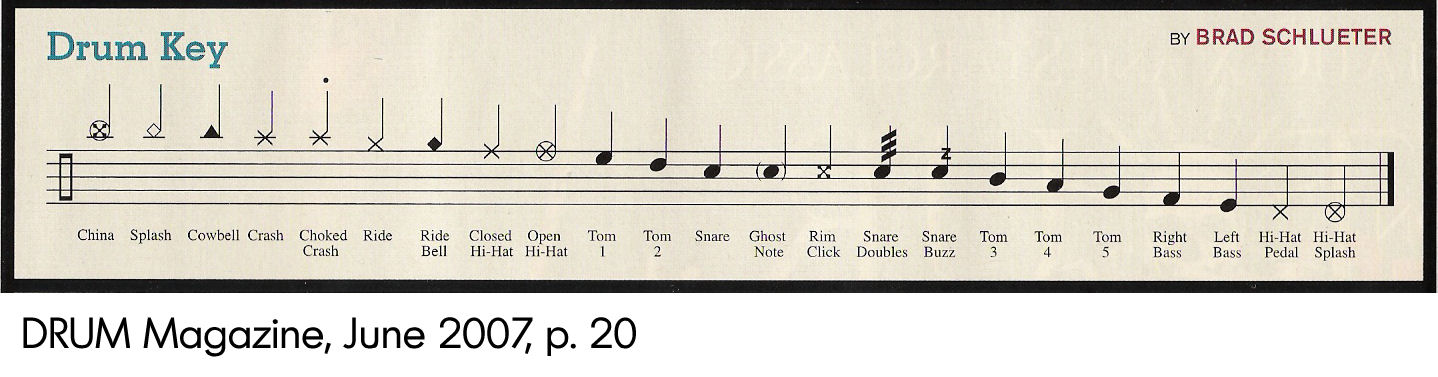
Here is a “legend” that musicaldog shared earlier…
This is relatively recent. You see can see the variation here. I have seen hi-hat notated on the top line. But not very common, and not very often in my experience. And certainly I have never seen open hi-hat written a different note head.
This all goes to show, that as long as you (the engraver) are consistent, there really isn’t anything you can’t do. Some things are more confusing that others.


 ). And worse, in the UI, if you want to remap instrument/technique to another number, YOU NEED TO DO BOTH STEPS ON ANOTHER NUMBER, meaning you are basically at square one. Thanks god it can be remapped efficiently in XML!